
Quantum Insights: Navigating the Future of HR
The Latest Expert Perspectives on the Changing Landscape of HR and People Management.
Keep Up with Our Latest News and Insights
Subscribe to Quantum Strategies' latest updates and insights.
All Blog Posts

Signs Your HR Tech Stack Is Holding Your Business Back
Most organizations do not realize their HR tech stack is broken until the damage is already done. Without a routine HR technology assessment, turnover increases, managers become frustrated, and HR is buried in manual work that a modern system should handle automatically.
HR technology that made sense three years ago may now create inefficiencies, data gaps, and compliance risks. Yet, many organizations continue operating without assessing whether their systems still meet business needs.
In consulting, an organization reached 150 employees and discovered its patchwork of disconnected systems had become a daily operational problem.
This guide provides a clear framework for assessing whether your current HR tech stack is supporting your organization or silently costing it time, money, and productivity.
What Is an HR Tech Stack?
Definition and Scope
An HR tech stack is the collection of software, platforms, and tools an organization uses to manage its HR functions. This can include an HRIS, payroll, ATS, performance management, learning management, benefits administration, time and attendance, employee engagement, and scheduling.
Organizations accumulate systems over time, adding software to solve individual problems without considering how the systems connect. This leads to disconnected systems, duplicate data entry, manual workarounds, and HR teams spending more time managing systems rather than managing people.
What a Functional HR Tech Stack Does
A functional HR tech stack automates administrative tasks, allowing HR to focus on strategy. It connects employee data across hiring, performance, compensation, and benefits in a single place, providing leadership with real-time visibility into workforce data.
What Most Organizations Actually Have
Most organizations have three to five disconnected HR systems that do not share data. To bridge the gaps, HR teams rely on manual exports and spreadsheets. Without a single source of truth for employee data, leaders are making decisions on incomplete or outdated workforce information.
The 7 Warning Signs Your HR Tech Stack Is Holding You Back
Sign 1 — Your HR Team Spends More Time on Admin Than on People
If HR is manually entering data into multiple systems, exporting reports to spreadsheets, or chasing approvals through email, the tech stack is failing them. In a well-automated environment, HR should spend no more than 30% of its time on administrative tasks.
According to SHRM, only 43% of HR professionals and employees consider their HR technology to be effective.
Sign 2 — Your Systems Don't Connect
When payroll doesn’t connect to HRIS, performance data lives separately from compensation, and the ATS doesn’t feed into onboarding, every handoff becomes a manual process and a potential error. In an integrated HR tech stack, a candidate accepted in the ATS automatically triggers onboarding, creates a payroll record, and assigns benefits enrollment.
Sign 3 — Managers Can't Get Answers Without Going Through HR
If a manager cannot access PTO balance, performance history, or goal status without emailing HR, then HR becomes a help desk instead of a strategic function, and managers feel unsupported. A modern HR tech stack provides managers with self-service access to the data needed to lead their teams.
Sign 4 — You Can't Answer Basic Workforce Questions
Questions such as current turnover rates by department, which recruiting sources produce the best hires, and who may be at risk of leaving within the next six months should be easy to answer. If answering these questions requires pulling data from multiple systems, then the HR tech stack is not supporting strategic decision-making.
Sign 5 — Compliance Is a Manual Process
If your team tracks FMLA manually, manages benefits compliance in spreadsheets, or produces EEO-1 reports by hand, every audit becomes reactive, and every compliance deadline carries unnecessary risk. HR technology should automate compliance tracking, flag issues before they become violations, and generate required reports on demand.
Sign 6 — The Employee Experience Is Fragmented
Employees use five different logins to manage benefits, check pay stubs, request time off, complete training, and update personal information. A fragmented employee experience is not just an inconvenience. It signals to employees that the organization is not organized and creates a poor first impression for new hires. A connected platform provides one employee portal that handles everything.
Sign 7 — Your Tech Stack Hasn't Been Audited in Over Two Years
Technology that was best in class a couple of years ago may now be significantly behind where the market is today. If no one has formally assessed whether your current tools still fit your needs, you are operating on assumptions. Organizations that do not audit their HR tech stack tend to add tools when problems emerge, rather than proactively building toward a connected system.
What a Strong HR Tech Stack Assessment Looks Like
Step 1: Map What You Have
Start by listing every HR tool currently in use, including name, function, cost, number of users, and date of implementation. Be sure to include tools managed by individual departments that still touch HR data, such as scheduling tools managed by operations and expense tools managed by finance.
Step 2: Identify Integration Gaps
For each tool, identify what it connects to, showing what data it produces and where that data goes. Any gap where data must be manually transferred represents a cost, a risk, and a delay. A key question is whether a candidate can move from offer acceptance to a fully set-up employee without any manual data entry.
Step 3: Calculate the Real Cost
It’s important to factor in the time HR teams spend on manual workarounds, error correction costs, compliance risk exposure, manager time lost waiting on HR, and employee frustration caused by poor self-service. Organizations discover that the hidden labor cost of managing a fragmented tech stack exceeds the cost of the software itself.
Step 4: Score Against Your Business Needs
Check your current stack on five dimensions:
Automation ensures repetitive tasks are handled automatically.
Integration allows data to flow between systems without manual transfer.
Self-service enables managers and employees to access what they need without HR involvement.
Analytics enables leadership to access workforce data quickly.
Scalability ensures the stack can support the organization at two times its current size.
Step 5: Define What Improvement Looks Like
Before evaluating new software options, take the time to define your organization's needs. Document your requirements, including what functions need to be automated, what integrations are critical, what reporting leadership needs, and what the employee experience should look like.
According to Gartner, only 24% of HR functions report maximizing the business value of their HR technology.
Point Solutions vs. Integrated Platforms — Which Is Right For You?
The Challenges of Point Solutions
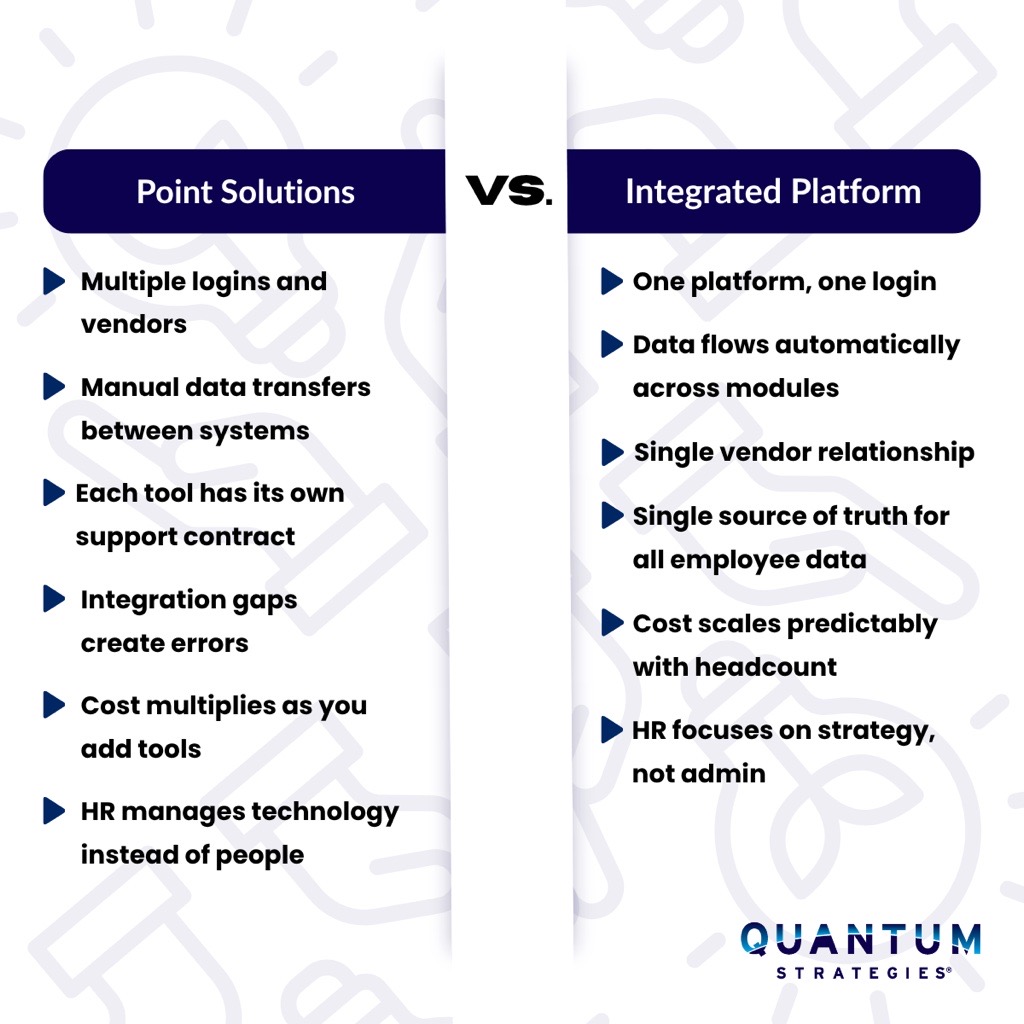
Most organizations build their HR tech stack by solving individual problems. The result is a stack of specialized tools that each do their job well in isolation, but create significant overhead when combined. Each point solution comes with its own login, data structure, support contract, and learning curve.
When Point Solutions Make Sense
Point solutions make sense in very large enterprise organizations with dedicated IT teams to manage integrations. Highly specialized needs also justify point solutions when a purpose-built tool significantly outperforms a module within an integrated platform. This approach can also be appropriate for organizations that have already invested heavily in a core HRIS and are filling specific functional gaps.
When an Integrated Platform Makes More Sense
Integrated platforms make more sense for mid-size organizations with 50 to 500 employees, where the HR team is small and cannot manage multiple vendors. This approach can also be appropriate for organizations where integration gaps are already creating significant manual work and data errors, or when the combined cost of point solutions plus the labor required to manage them exceeds an integrated platform.
The Maximum Accountability Approach
Maximum Accountability is an integrated HR technology platform built by Quantum Strategies. The platform combines 12 ready-to-deploy modules, including performance management, people analytics, employee engagement, succession planning, applicant tracking, learning management, and benefits administration into a single system that connects with existing HRIS, payroll, and ERP platforms.
The all-in-one approach is for companies that need enterprise-grade HR tools without the complexity and cost of enterprise software. Ultimately, Maximum Accountability provides one platform, one employee portal, and one source of truth for workforce data.
How to Build a Business Case for HR Technology Investment
Quantify the Cost of the Status Quo
Start by calculating the annual cost of manual work by multiplying HR administrative hours per week by the fully loaded hourly rate. Then, add in the estimated cost of compliance errors, turnover related to a poor employee experience, and manager time lost to HR inefficiencies.
For example, three HR employees spending 15 hours per week on manual data entry equate to 2,340 hours per year. At a fully loaded hourly rate of $35, that represents $81,900 annually spent on work that technology should be handling.
Define the ROI of Better Technology
Consider what HR could accomplish if automation eliminated 15 hours of administrative tasks each week, how automated compliance tracking could reduce risk, how manager self-service could improve satisfaction, and how a strong onboarding experience could increase 90-day retention.
Present Options, Not Just a Request
Present to leadership two to three options at different investment levels, detailing what each option solves, what it costs, and the projected ROI over 12 to 24 months. Decision makers who are presented with clear options make faster decisions than those given a single recommendation.
Taking the First Step
An HR tech stack assessment does not require a massive consulting engagement; it requires honest answers to a few direct questions. Start with the 7 warning signs above. If three or more apply, the stack is worth a formal audit.
The goal is not to rip and replace everything at once, but to understand where the gaps are and build a roadmap toward a connected, scalable system.
Quantum Strategies works with organizations to assess their current HR technology, identify gaps, and build a technology roadmap that fits their size, budget, and growth plan. Contact us to schedule a consultation.

Unlock Your HR Potential
Subscribe and stay ahead with the latest in HR innovation
Connect


Keep Up with Our Latest News and Insights
Subscribe to Quantum Strategies' latest updates and insights.
Office: Philadelphia, PA | Glen Mills, PA | Washington, DC
Call 610.624.1770
Email: info@QS2500.com
Site: www.QS2500.com