Tailored HR Solutions as Unique as Your Business
Expert consulting and service to elevate your HR from a headache to a value driver.
Does Your HR Function Make the Grade?
Take our 5-minute quiz and evaluate the effectiveness of your HR function.

How We Help
We Focus on Your HR Needs,
So You Can Focus on Your Mission.
At Quantum Strategies, we understand that effective human resource management is the cornerstone of every successful business, regardless of size. Our mission is to provide tailored HR solutions that align perfectly with your unique business needs and growth stage.
Our Services
Navigating Change with Confidence: Quantum Expert HR Solutions
From Policy Assistance to Leadership Succession Planning, Quantum Strategies is Your Ultimate HR Resource to Solve Your Business Challenges.
HR Operational
Assessments
Unlock the full potential of your HR department. Our collaborative approach brings clarity and efficiency to your HR operations, providing a thorough analysis of your department's structure, costs, effectiveness, and needs.
Comprehensive Analysis: Detailed evaluation of your organization, workgroups, and individual roles for optimized efficiency.
Objective Insights: Receive a clear blueprint highlighting your HR department's strengths, weaknesses, and gaps.
Strategic Recommendations: Actionable plans focusing on technology utilization, communication enhancement, and leveraging department strengths.
HR Consulting and Managed Services
Tailored to align with your unique needs, our HR consulting and managed services enhance operational efficiency and effectiveness, allowing you to focus on your core mission while we optimize your HR investment.
Expert Supplemental Support: Strengthen your existing HR team with specialized expertise to navigate complex HR landscapes.
Personalized, Agile Solutions: Customized services for organizations with or without HR teams, adaptable to your specific requirements.
Goal-Oriented, Clear Communication: Delivering precise, actionable strategies that align with your organization’s goals and ensure successful execution.
Custom HRIS Design and Integration
Revolutionize your HR data management. Our team will evaluate your current human resources technology stack, offer recommendations, and then integrate your new and existing systems with our cutting-edge technology, ensuring seamless data flow and optimized operational efficiency.
Seamless Integration: Connect legacy systems with modern platforms for streamlined data management.
Tailored Design: Custom HRIS solutions uniquely crafted to meet your specific business needs.
Advanced Analytics: Leverage data-driven insights for strategic decision-making and operational excellence.
“Successfully steering through the specialized HR challenges within organizations of all kinds demands expert understanding, strategic planning, and precise implementation. With comprehensive knowledge of these challenges and the right solutions, your business can stay focused and successful in their vital missions.”
William J. Rizzo

Who we Are.
We Focus on Your HR Needs,
So You Can Focus on Your Mission.
At Quantum Strategies, we recognize that proficient management of human resources is fundamental to the success of any enterprise, irrespective of its scale. Our objective is to deliver customized human resource solutions that are in perfect harmony with your distinct business requirements and developmental phase.
Constant Improvement
Commitment to Customers
High Level Of Knowledge
Best Service You Can Get

Why Choose Us
A True Partner to Solve Your Most Complex HR Challenges.
Empowering HR Innovation and Compliance
Commitment to 100% Client Satisfaction
People-First Approach

Peace of Mind:
Handle ongoing compliance with ease

Employee Satisfaction:
Build a positive workplace with engaged employees

Strategic Confidence:
Drive strategy with advanced analytics

Leadership Development:
Equip your team with the tools to lead

2,245 +
Happy Clients

25 +
Years Of Experience

120 +
Professional Team
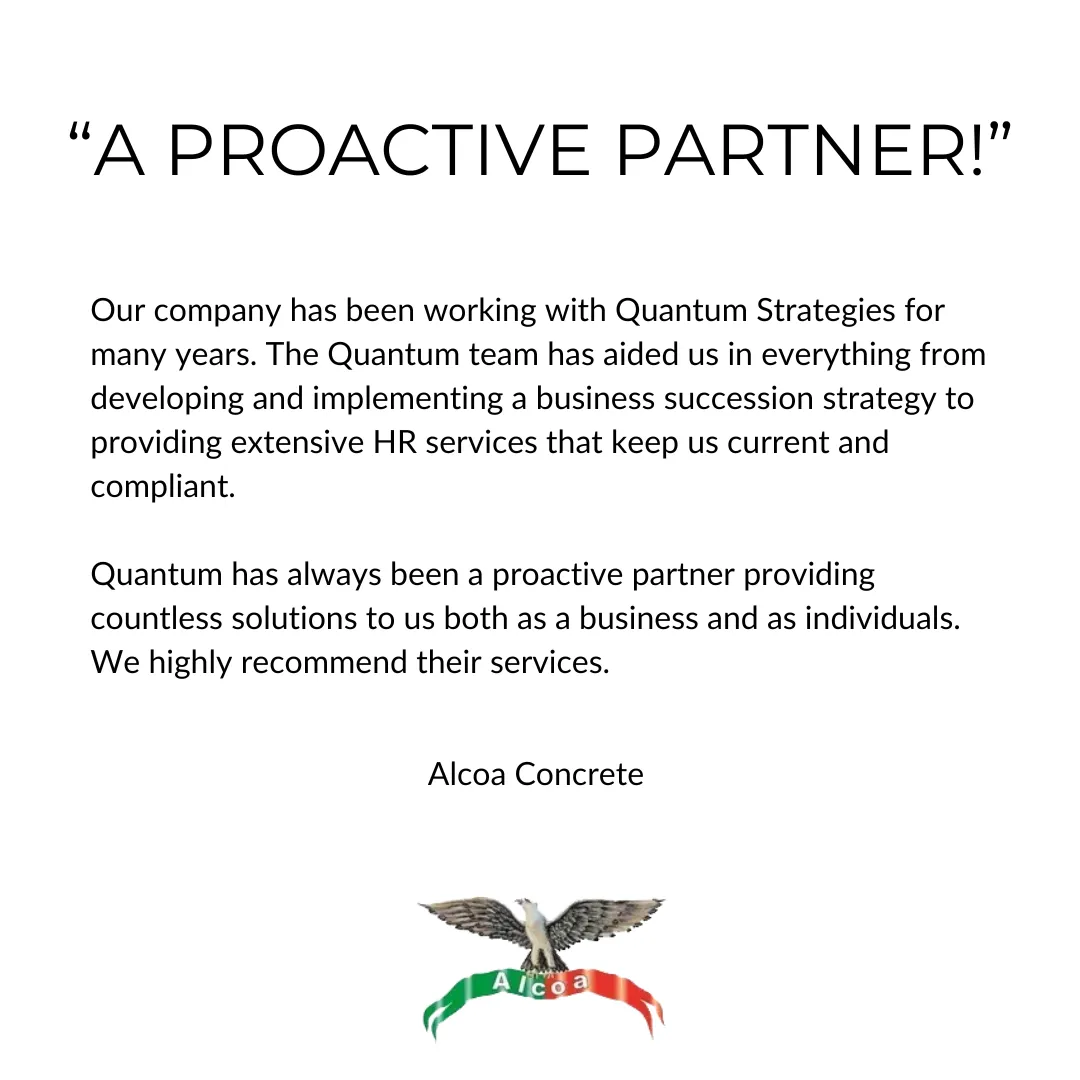
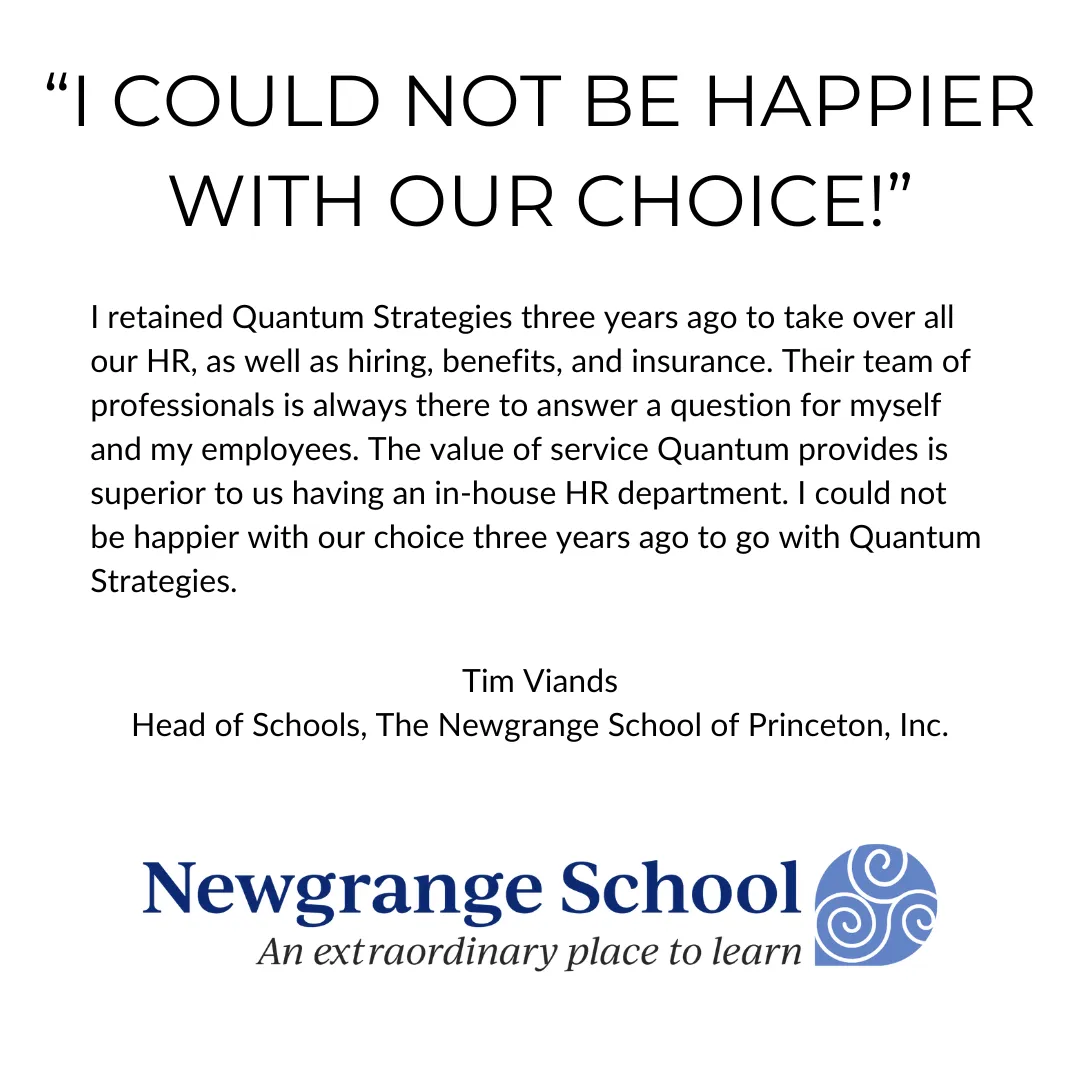
Testimonials
The Quantum Commitment - 100% CLIENT SATISFACTION!
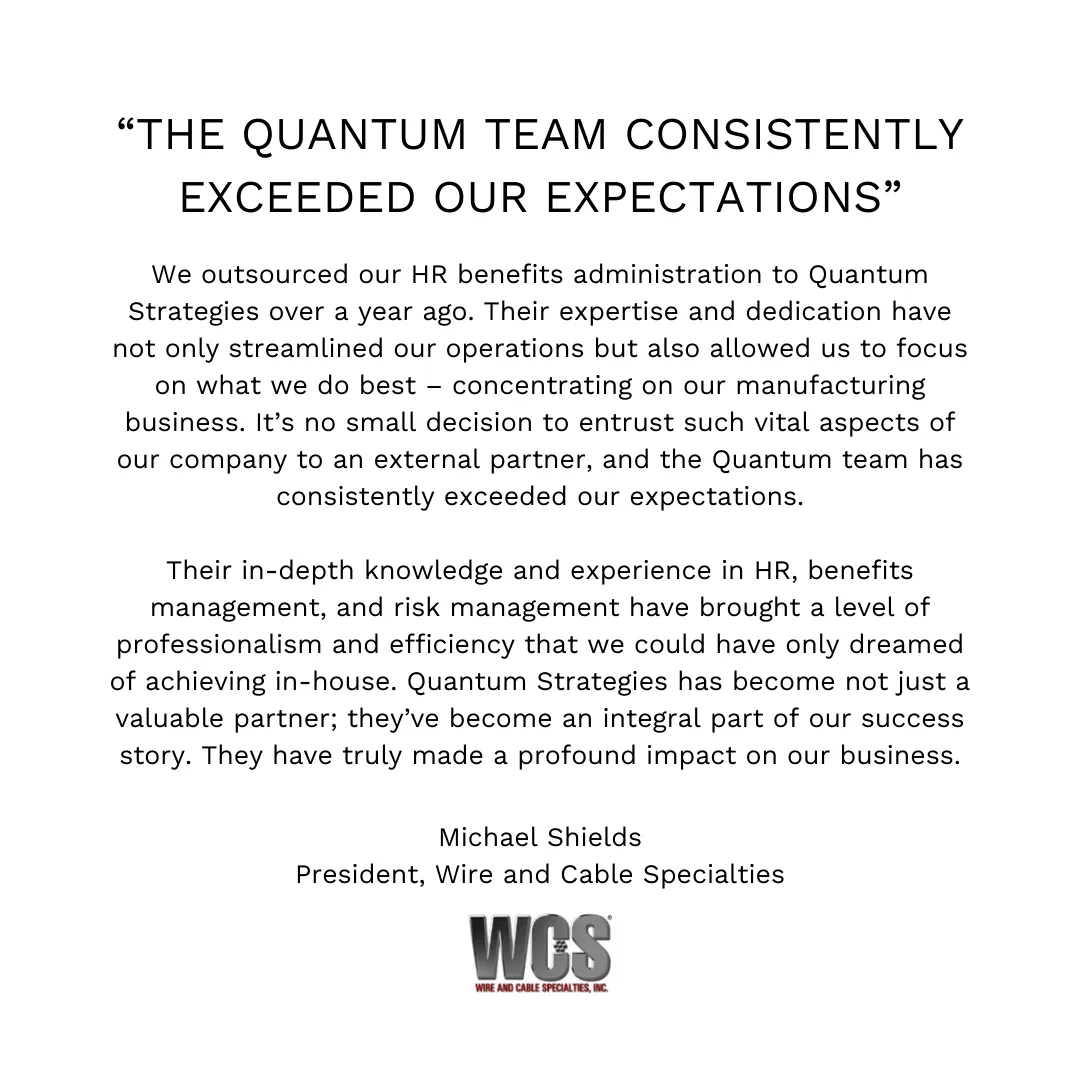
At Quantum, we understand that your satisfaction matters most, and The Quantum Commitment is our way of putting that understanding into action. Experience the difference with a team that is dedicated to making your satisfaction the cornerstone of our service. Because when you choose Quantum, you choose excellence, reliability, and a commitment to exceeding your expectations every time.
Our Resources
Unveiling Proven Strategies and Insights.
Discover actionable tips, expert advice, and industry insights to fuel your journey towards success.


Fostering a Psychologically Safe Workspace
As we navigate the complexities of the post-pandemic world, the importance of mental health in the workplace has surged to unprecedented levels. According to research from the
American Psychological Association, 81% of employees are now actively seeking workplaces prioritizing mental well-being.

Key Challenges Faced by Human Resources in Nonprofit Organizations
The nonprofit sector brings its own set of specialized difficulties, especially in the area of human resources (HR). Although these difficulties may share some common ground with those in the for-profit industry, they possess unique characteristics that require special attention from nonprofit leaders.

Maximizing Business Performance with HR Analytics: Harnessing Data-Driven Insights for Effective People Management
HR analytics involves collecting, analyzing, and reporting data related to human resource management within an organization.
FOUND THESE HELPFUL?
Explore Additional Articles and Resources In Our Blog

HR Digital Transformation: What to Build, Buy, and Stop Doing
Every HR leader knows digital transformation is coming. Most don't know where to start, which leads them to buy software they don't need yet, spend years building a custom solution, or continue doing what they've always done while calling it an HR digital transformation roadmap.
In consulting, a 200-employee organization spent $180,000 on an enterprise HRIS built for 2,000 employees. Two years later, HR was still using spreadsheets alongside the new system because the implementation was too complex and the team never fully adopted it.
The build, buy, stop framework provides HR leaders and CEOs with a simple strategy that prevents over-investment, under-investment, and the most expensive mistake of all, doing nothing.
This guide provides a practical overview of how to decide what to build, buy, and stop doing when developing an HR digital transformation roadmap.
What Is HR Digital Transformation?
Definition and Scope
HR digital transformation is the process of replacing manual, paper-based, and disconnected HR processes with integrated technology that automates administrative work, connects workforce data, and provides leadership with real-time visibility into people decisions.
What HR Digital Transformation Is Not
HR digital transformation is not simply an HRIS upgrade where organizations swap one system for another without improving the underlying processes.
It is not about automating everything at once. Prioritization is the difference between a transformation that gains traction and one that collapses under its own scope.
It is not an IT project alone. A successful HR digital transformation requires HR leadership, CEO sponsorship, and manager buy-in. IT supports the implementation, but HR owns the strategy.
Why Mid-Size Organizations Need to Prioritize HR Digital Transformation
For organizations with fewer than 50 employees, manual HR processes are manageable. Once a company grows beyond 150 employees, those same processes start to break down.
Consequently, HR teams become reactive, managers rely on HR for basic information, compliance deadlines are tracked manually, and onboarding becomes inconsistent.
The Framework — Build, Buy, Stop
Why This Framework Works
Most HR technology decisions happen reactively, with a problem surfacing, a tool being recommended, a budget being approved, and implementation moving forward without first evaluating whether it is the right solution.
The build, buy, stop framework creates a more proactive approach by requiring organizations to audit their processes before making any technology decisions.
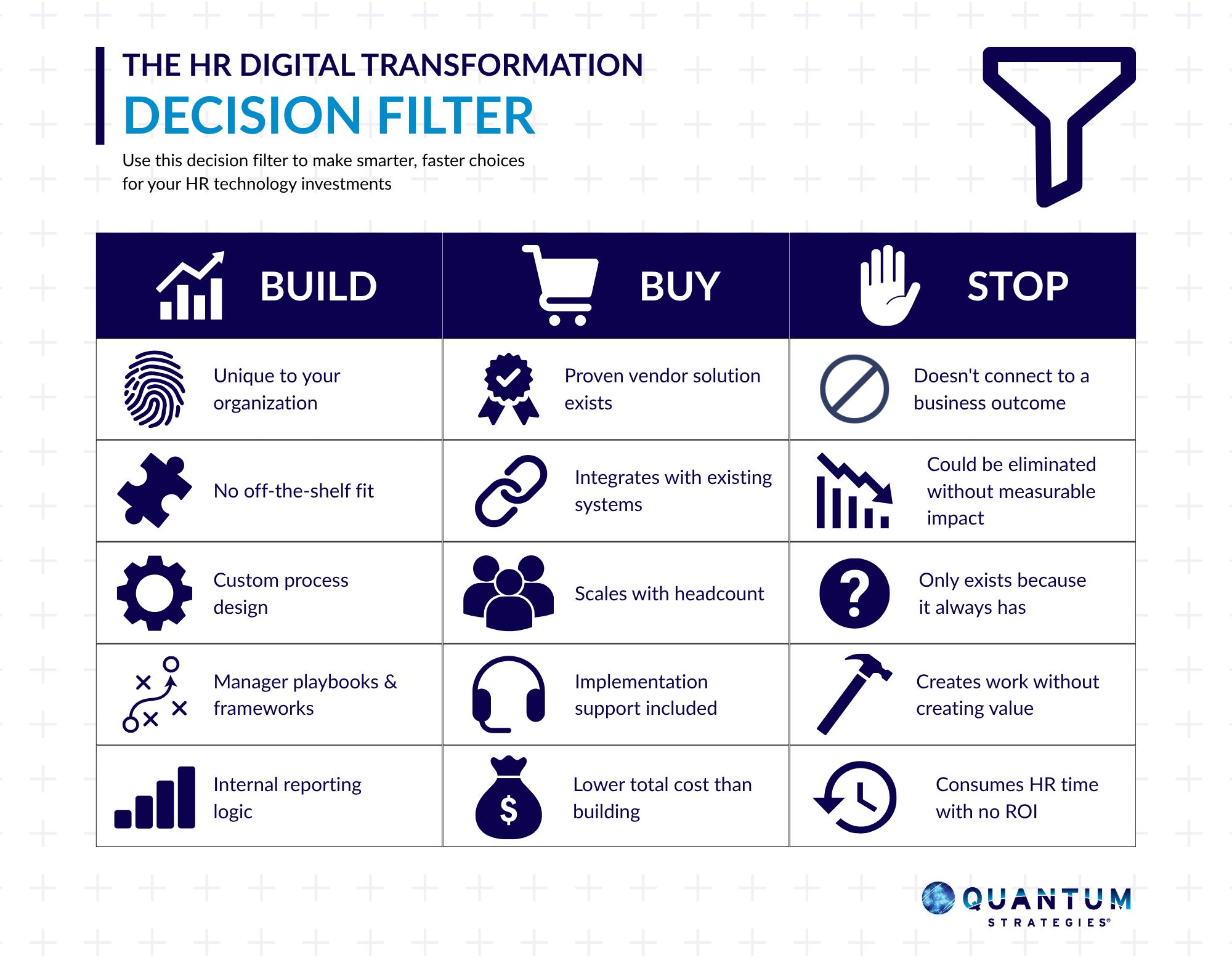
In addition, the build, buy, stop framework asks organizations to identify what needs to be created from scratch, what should be purchased from a vendor, and what existing processes should be stopped.
BUILD — What to Create Internally
Build when a process is unique to your organization, no vendor solution fits your specific workflow, or the investment in a custom solution provides a faster return than buying an existing option.
Common build decisions in HR transformation include custom reporting dashboards that pull from existing systems, internal process documentation and workflow maps, manager playbooks and onboarding guides, and competency frameworks and job architecture.
Build does not mean creating technology from scratch for mid-size organizations. Instead, it means designing the process first and then selecting the technology that supports it.
BUY — What to Purchase from a Vendor
Buy when a proven solution already exists, the vendor’s implementation support reduces risk, and the total cost of ownership is lower than building and maintaining the solution internally.
HR functions that are typically better suited to buying rather than building include HRIS and people data management, payroll processing, benefits administration, applicant tracking, learning management, performance management, employee engagement surveys, leave management, and compliance tracking.
When selecting a vendor, organizations should consider integration capabilities with existing systems, implementation support that does not require a six-month consulting engagement, and pricing that scales with headcount.
STOP — What to Eliminate
Stopping refers to identifying HR processes that exist only because they have always existed, not because they create value.
Common processes to stop during HR transformation include manual headcount reports, outdated annual performance reviews, paper-based approvals that create delays, and compliance training that runs on autopilot without measuring retention.
A rule for identifying what to stop is to evaluate whether a process connects to a business outcome and whether removing it would create a measurable problem. If it does not, it is a candidate for elimination.
How to Build Your HR Digital Transformation Roadmap
Step 1: Audit Your Current State
Before making any decisions, document what HR currently does, how it does it, and what tools support each function. For each process, determine whether it is manual or automated, how long it takes, who owns it, and what breaks most often.
According to SHRM, 19% of HR roles involve at least 50% of tasks that are already automated, highlighting the need to understand which processes are ready for optimization, and which still require redesign.
Step 2: Prioritize by Business Impact
Prioritize the work by identifying which processes are costing the business the most and focus on those first. High-priority areas often include processes that affect the employee experience, such as onboarding, payroll accuracy, and benefits enrollment.
Additionally, prioritize processes that create compliance risk, such as leave management, I-9 tracking, and EEO reporting.
Step 3: Apply the Build, Buy, Stop Framework
Take your prioritized list and evaluate each process using the build, buy, stop framework.
For each process, ask whether you need a custom solution or if an existing tool can support it. Determine whether there is a proven platform that integrates with your current systems and can be implemented without a lengthy project. Lastly, consider whether the process needs to exist at all and what would happen if it were eliminated tomorrow.
Document each decision and the reasoning behind it to create the foundation of your HR digital transformation roadmap.
Step 4: Sequence the Roadmap
Avoid transforming everything at once by sequencing the roadmap based on dependencies and organizational capacity.
Phase 1 focuses on building the foundation with HRIS, payroll integration, and basic reporting.
Phase 2 focuses on operations by automating high-volume manual processes, such as benefits enrollment, leave management, and compliance tracking.
Phase 3 focuses on strategy by implementing tools for performance management, people analytics, succession planning, and learning management.
Each phase should deliver measurable results before the next phase begins.
Step 5: Plan for Change Management Before You Plan for Technology
Managers who do not understand why a new process exists may work around it, while employees who are not involved in the transformation may resist it.
A transformation management checklist should communicate the why before the what, involve managers in the design phase, provide training before go-live, and build a feedback loop for the first 90 days.
The Most Common HR Digital Transformation Mistakes
Mistake 1 — Starting With Technology Instead of Process
Buying a system before designing the process allows the technology to run HR instead of supporting it.
To fix this, document the ideal process first, then evaluate whether a vendor’s solution fits that process rather than changing the process to fit the technology.
Mistake 2 — Trying to Solve Everything in Phase 1
Organizations that try to implement payroll, performance management, ATS, and engagement surveys all at once often struggle to complete any of them successfully.
To fix this, phase the roadmap by completing phase 1 before moving to the next. In addition, measure results at each phase to ensure progress before continuing.
According to McKinsey, organizations that clearly prioritize HR digital transformation initiatives are 2.7 times more likely to report success.
Mistake 3 — No Executive Sponsorship
HR digital transformation requires the CEO to support the initiative, not just approve the budget. When transformation stalls at the manager level, HR needs the CEO to reinforce the importance of the change.
To fix this, the CEO should communicate the why behind the transformation, while HR communicates what is changing and how the organization will move forward.
Mistake 4 — Ignoring Integration
Buying multiple tools that do not connect creates the same problems organizations are trying to solve, including fragmented data and manual workarounds.
To fix this, make integration a non-negotiable requirement when evaluating new tools. Every platform should connect with your HRIS without requiring a custom development project.
Mistake 5 — Measuring the Wrong Outcomes
Tracking whether the system was implemented on time does not measure whether the transformation was successful.
To fix this, define success metrics before implementation, such as HR administrative hours per week, manager self-service adoption rates, time-to-fill open roles, compliance incident rates, and employee satisfaction with HR processes.
The Complete HR Technology Ecosystem Explained
The Core Stack for a Mid-Size Organization
A mid-sized organization with 50 to 500 employees needs technology across six key functional areas. These include an HRIS, talent acquisition, performance and development, compensation and benefits, employee experience, and analytics and reporting.
The goal is to connect these six areas into one integrated ecosystem rather than managing six separate tools with disconnected data models.
The Case for an Integrated Platform
Six separate specialized HR tools require six vendor relationships, six renewal negotiations, six integration projects, and six sources of data that rarely align.
An integrated platform manages all six areas through one login, one data model, and one vendor relationship.
While integrated platforms may not offer the same depth across all areas, they are the better choice for mid-sized organizations that do not have the IT resources to manage a multiple-vendor ecosystem.
Maximum Accountability Supports HR Digital Transformation
Maximum Accountability is an integrated HR technology platform built by Quantum Strategies. Maximum Accountability's 12 ready-to-deploy modules cover every layer of the core HR technology stack, including performance management, people analytics, succession planning, applicant tracking, learning management, compensation analytics, leave management, benefits administration, scheduling, position analysis, and wellness.
Every module integrates with existing HRIS, payroll, and ERP systems, allowing organizations to fill technology gaps with an integrated platform without replacing systems that are already working.
For organizations pursuing an HR digital transformation strategy, the build, buy, stop framework helps identify when an integrated HR technology platform such as Maximum Accountability is the right choice over building custom solutions or managing multiple point solutions.
How Quantum Strategies Helps Organizations Build HR Digital Transformation Roadmaps
A successful HR digital transformation starts with an honest audit of what is broken, applying the build, buy, stop framework to every process, sequencing the HR digital transformation roadmap in phases, and investing in change management before investing in software.
Quantum Strategies helps organizations build HR digital transformation roadmaps, from the initial audit through implementation and adoption.
At Quantum Strategies, our approach is to start by assessing your current state, apply the build, buy, stop framework to your HR processes, and develop a phased roadmap that aligns with your size, budget, and growth goals.
Ready to build your HR digital transformation roadmap? Contact us to schedule a consultation.
Want to see what an integrated HR technology ecosystem looks like in practice? Explore Maximum Accountability.

Connect


Keep Up with Our Latest News and Insights
Subscribe to Quantum Strategies' latest updates and insights.
Office: Philadelphia, PA | Glen Mills, PA | Washington, DC
Call 610.624.1770
Email: info@QS2500.com
Site: www.QS2500.com