
Tailored HR Solutions as Unique as Your Business
Expert consulting and service to elevate your HR from a headache to a value driver.
Does Your HR Function Make the Grade?
Take our 5-minute quiz and evaluate the effectiveness of your HR function.

How We Help
We Focus on Your HR Needs,
So You Can Focus on Your Mission.
At Quantum Strategies, we understand that effective human resource management is the cornerstone of every successful business, regardless of size. Our mission is to provide tailored HR solutions that align perfectly with your unique business needs and growth stage.
Our Services
Navigating Change with Confidence: Quantum Expert HR Solutions
From Policy Assistance to Leadership Succession Planning, Quantum Strategies is Your Ultimate HR Resource to Solve Your Business Challenges.
HR Operational
Assessments
Unlock the full potential of your HR department. Our collaborative approach brings clarity and efficiency to your HR operations, providing a thorough analysis of your department's structure, costs, effectiveness, and needs.
Comprehensive Analysis: Detailed evaluation of your organization, workgroups, and individual roles for optimized efficiency.
Objective Insights: Receive a clear blueprint highlighting your HR department's strengths, weaknesses, and gaps.
Strategic Recommendations: Actionable plans focusing on technology utilization, communication enhancement, and leveraging department strengths.
HR Consulting and Managed Services
Tailored to align with your unique needs, our HR consulting and managed services enhance operational efficiency and effectiveness, allowing you to focus on your core mission while we optimize your HR investment.
Expert Supplemental Support: Strengthen your existing HR team with specialized expertise to navigate complex HR landscapes.
Personalized, Agile Solutions: Customized services for organizations with or without HR teams, adaptable to your specific requirements.
Goal-Oriented, Clear Communication: Delivering precise, actionable strategies that align with your organization’s goals and ensure successful execution.
Custom HRIS Design and Integration
Revolutionize your HR data management. Our team will evaluate your current human resources technology stack, offer recommendations, and then integrate your new and existing systems with our cutting-edge technology, ensuring seamless data flow and optimized operational efficiency.
Seamless Integration: Connect legacy systems with modern platforms for streamlined data management.
Tailored Design: Custom HRIS solutions uniquely crafted to meet your specific business needs.
Advanced Analytics: Leverage data-driven insights for strategic decision-making and operational excellence.
“Successfully steering through the specialized HR challenges within organizations of all kinds demands expert understanding, strategic planning, and precise implementation. With comprehensive knowledge of these challenges and the right solutions, your business can stay focused and successful in their vital missions.”
William J. Rizzo

Who we Are.
We Focus on Your HR Needs,
So You Can Focus on Your Mission.
At Quantum Strategies, we recognize that proficient management of human resources is fundamental to the success of any enterprise, irrespective of its scale. Our objective is to deliver customized human resource solutions that are in perfect harmony with your distinct business requirements and developmental phase.
Constant Improvement
Commitment to Customers
High Level Of Knowledge
Best Service You Can Get



Why Choose Us
A True Partner to Solve Your Most Complex HR Challenges.
Empowering HR Innovation and Compliance
Commitment to 100% Client Satisfaction
People-First Approach

Peace of Mind:
Handle ongoing compliance with ease

Employee Satisfaction:
Build a positive workplace with engaged employees

Strategic Confidence:
Drive strategy with advanced analytics

Leadership Development:
Equip your team with the tools to lead

2,245 +
Happy Clients

25 +
Years Of Experience

120 +
Professional Team
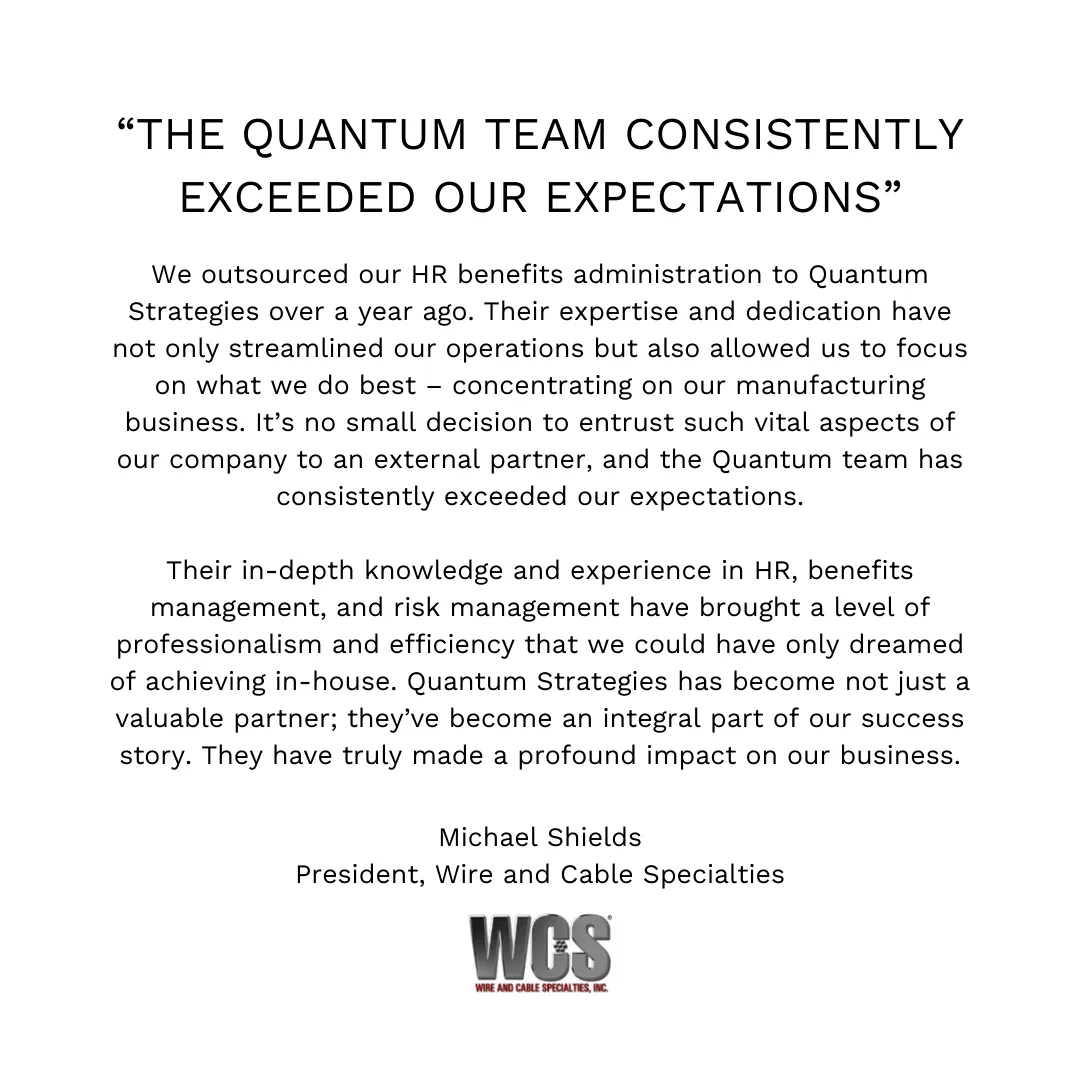
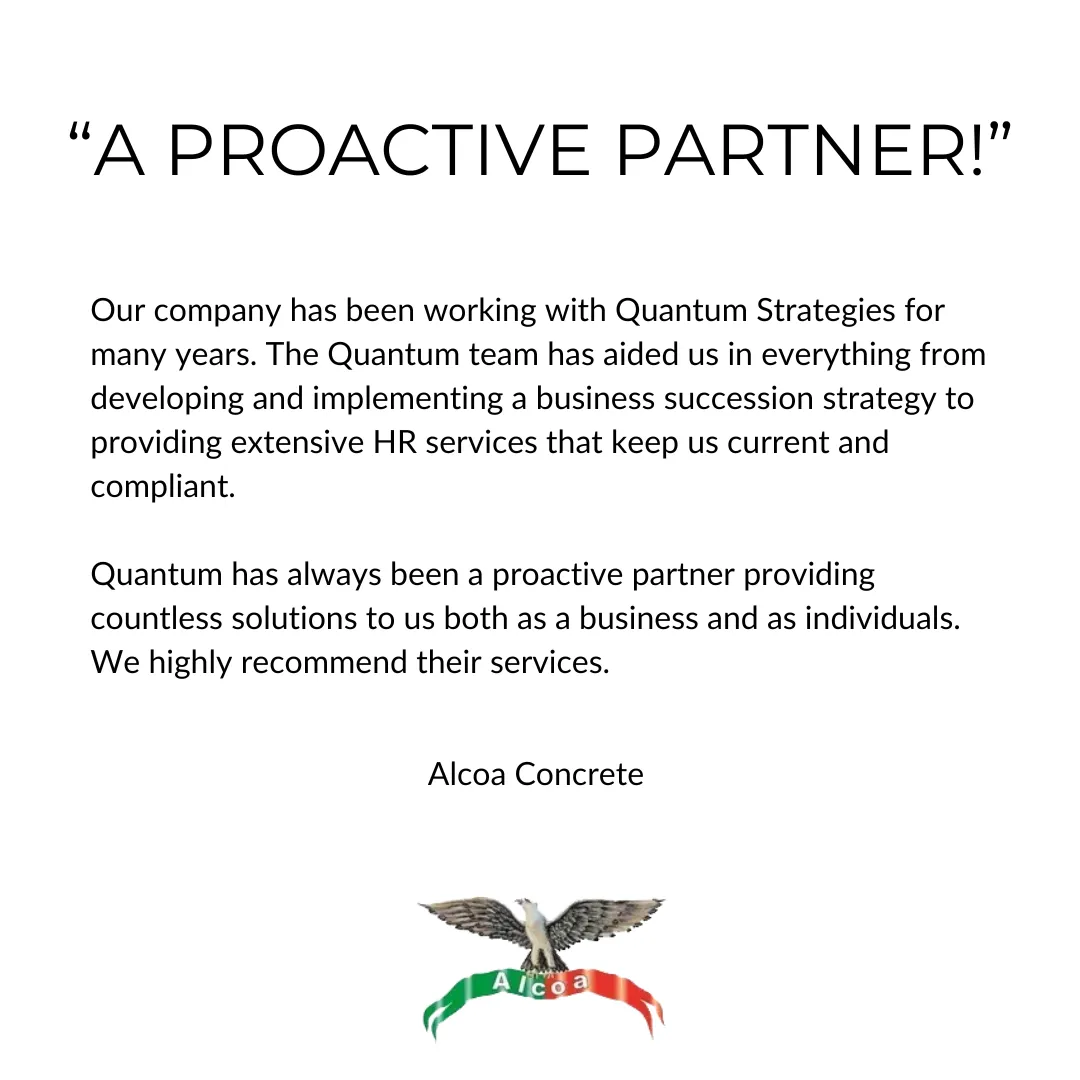
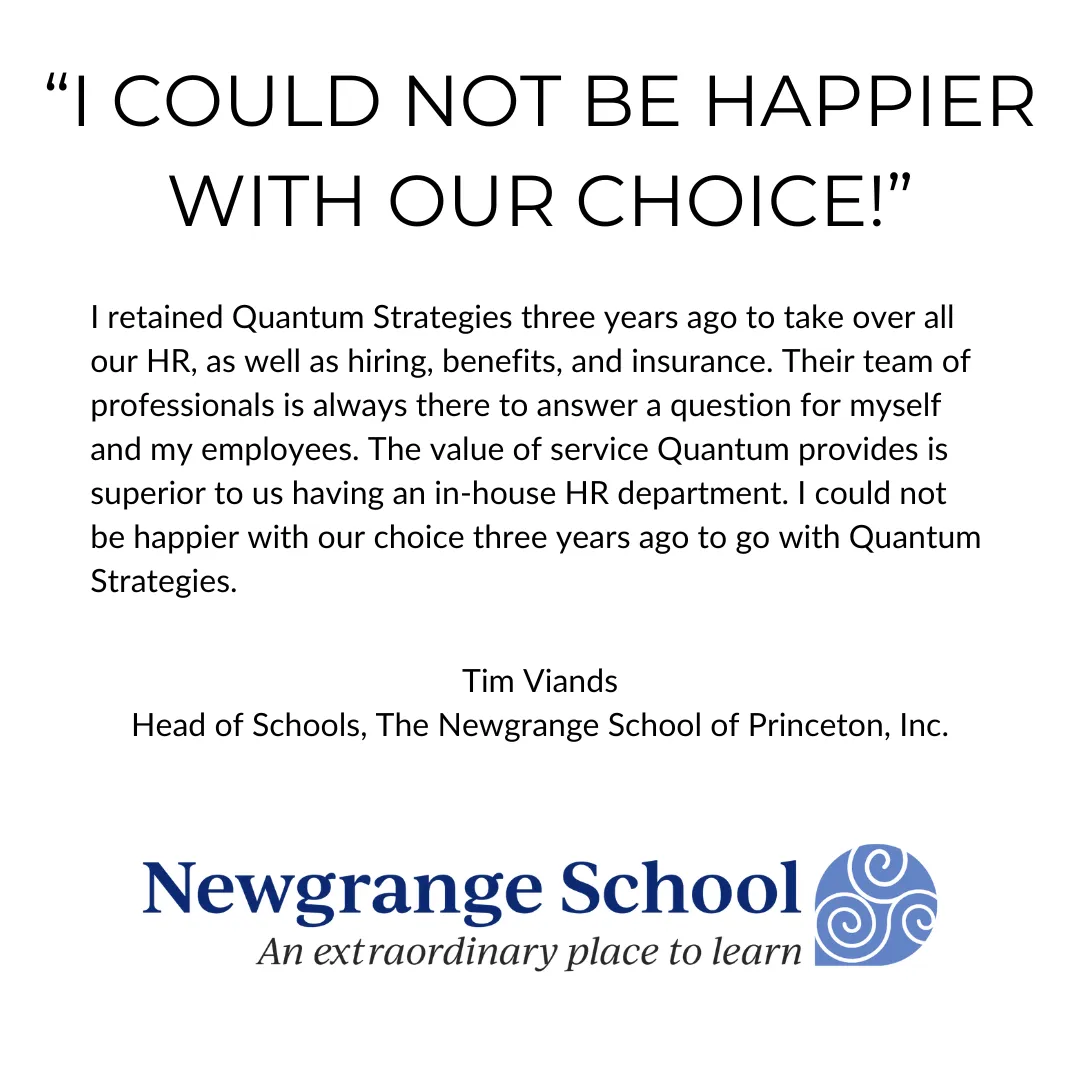
Testimonials
The Quantum Commitment - 100% CLIENT SATISFACTION!
At Quantum, we understand that your satisfaction matters most, and The Quantum Commitment is our way of putting that understanding into action. Experience the difference with a team that is dedicated to making your satisfaction the cornerstone of our service. Because when you choose Quantum, you choose excellence, reliability, and a commitment to exceeding your expectations every time.
Our Resources
Unveiling Proven Strategies and Insights.
Discover actionable tips, expert advice, and industry insights to fuel your journey towards success.


Fostering a Psychologically Safe Workspace
As we navigate the complexities of the post-pandemic world, the importance of mental health in the workplace has surged to unprecedented levels. According to research from the
American Psychological Association, 81% of employees are now actively seeking workplaces prioritizing mental well-being.

Key Challenges Faced by Human Resources in Nonprofit Organizations
The nonprofit sector brings its own set of specialized difficulties, especially in the area of human resources (HR). Although these difficulties may share some common ground with those in the for-profit industry, they possess unique characteristics that require special attention from nonprofit leaders.

Maximizing Business Performance with HR Analytics: Harnessing Data-Driven Insights for Effective People Management
HR analytics involves collecting, analyzing, and reporting data related to human resource management within an organization.
FOUND THESE HELPFUL?
Explore Additional Articles and Resources In Our Blog

The HR Business Partner Model: From Support to Strategy
Most HR teams operate as order-takers—processing requests, answering questions, filling roles—but never get a seat at the leadership table. In many organizations, these traditional HR structures keep HR teams stuck in administrative mode while business leaders make critical decisions without HR input.
However, the HR Business Partner (HRBP) model repositions HR as a strategic advisor embedded in the business, driving performance through people strategy. Instead of focusing on administrative tasks, the HRBP model supports long-term success through HR transformation across workforce planning, talent management, organizational development, and overall business advancement.
In consulting, implementing the HRBP model has transformed HR’s role across organizations. For organizations seeking to explore how to build a more strategic HR operating model, consider HR transformation support through HR strategies.
What Is the HR Business Partner Model?
Definition and Core Concept
An HRBP (Human Resource Business Partner) is a strategic HR professional embedded within business units, acting as a consultant and advisor to leaders. HRBP responsibilities include connecting people strategy to business strategy, representing business needs to HR, and representing HR capabilities to the business.
The Three-Legged Stool: HR Operating Model
HRBPs serve as strategic advisors embedded within business units. COEs are deep specialists, providing expertise in talent acquisition, compensation, learning and development, and organizational development. Shared Services manages transactions, such as payroll, benefits administration, and HR operations. This HR operating model allows HR teams to focus less on administrative tasks and more on strategic value.
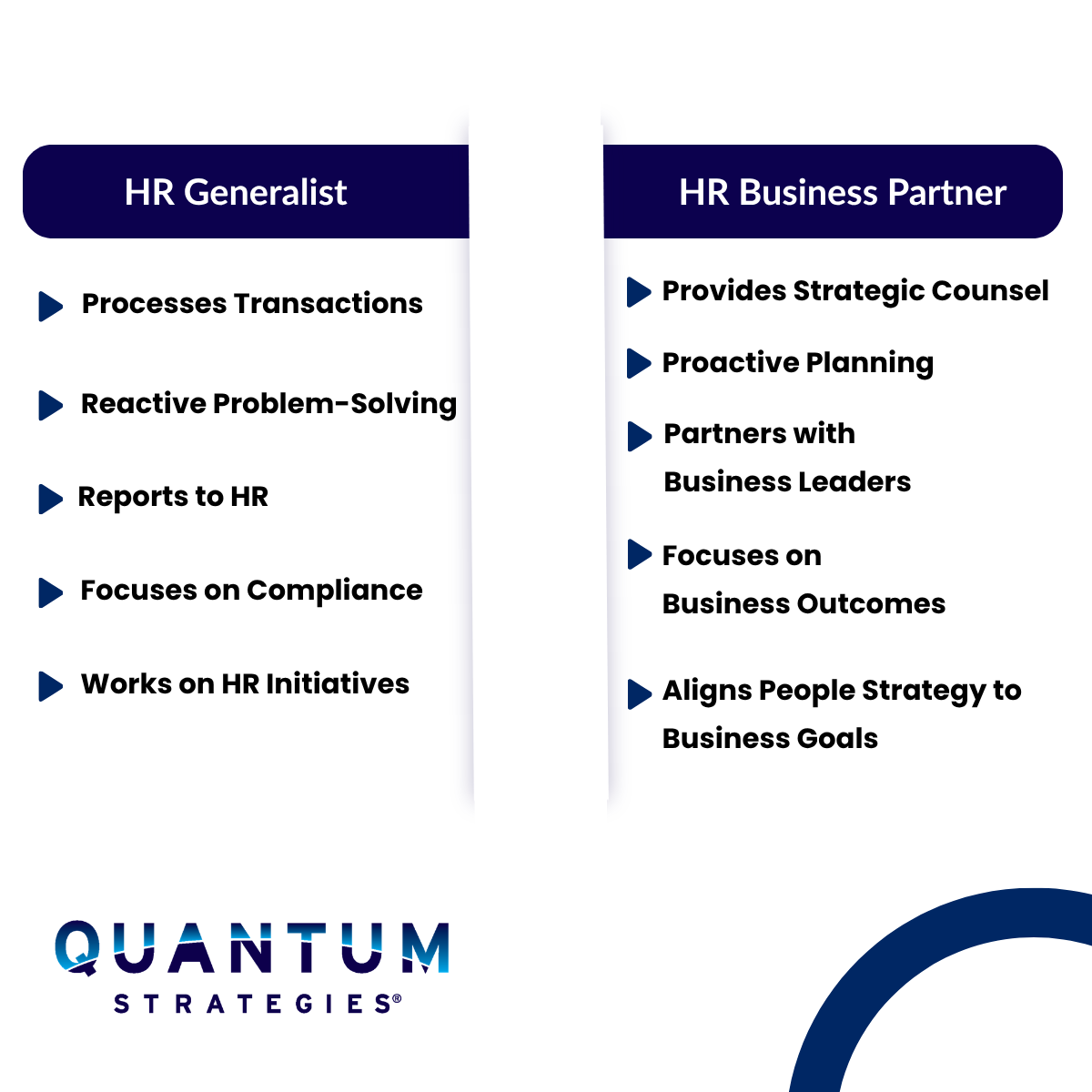
HR Business Partner vs. HR Generalist
HRBPs focus on strategic partnership, talent strategy, and organizational effectiveness, while HR Generalists perform a variety of tasks, including recruiting, benefits, employee relations, and compliance. The key difference is that HRBPs do not process transactions—they consult on business problems through a people lens.
Why Organizations Adopt the HRBP Model
Problem 1: HR Is Stuck in Admin Model
HR teams often spend most of their time on administrative tasks, leaving limited time for strategic work. As a result, business leaders may not fully recognize HR’s value.
Problem 2: Disconnect Between HR and the Business
HR creates programs without fully understanding business needs. For example, HR may launch an engagement initiative while a business unit is struggling with a product launch, establishing the wrong priorities. Without HR input, business leaders make decisions such as promotions, organizational changes, and hiring plans.
Problem 3: Inconsistent HR Service Across the Organization
Each HR generalist may interpret policies differently. The quality of HR support depends on which HR representative an employee works with. HR generalists lack the specialized expertise; therefore, they are unable to address complex issues.
The Business Case for HRBP Model
The HRBP model improves business alignment, HR impact, talent outcomes, and scalability through shared services. According to Deloitte, HR Business Partners must “align people priorities with business priorities” and use workforce insights to drive organizational performance.
Core Responsibilities of an HR Business Partner
Strategic Workforce Planning
HRBPs partner with business leaders to forecast talent needs, identify skill gaps, develop plans to close those gaps, and support succession planning. For example, if a business unit is planning a market expansion, the HRBP would analyze talent needs, create a hiring timeline, and evaluate the organizational structure.
Talent Management and Development
HRBPs advise hiring decisions, coach managers, design development plans, and drive retention strategies. Learn more about how leaders can empower teams and accelerate growth.
Organizational Effectiveness
HRBPs address organizational design issues, facilitate leadership team alignment, and support change management. For example, if a department is struggling with collaboration, the HRBP facilitates a team effectiveness workshop and redesigns the meeting structure.
Employee Relations and Culture
HRBPs advise leaders on difficult people situations, monitor engagement and culture within their business unit, and surface trends and potential risks to leadership. Learn more about how to cultivate psychological safety in the workplace.
Data-Driven Insights
HRBPs analyze workforce metrics for their business unit, identify patterns, recommend actions, and translate people data into business impact. For example, if there is a spike in turnover within the sales team, the HRBP may analyze exit interview data, identify management issues, and coach the leader on team management.
Strategic Advisor to Leadership
HRBPs maintain regular one-on-one meetings with business unit leaders, participate in leadership team meetings, influence decisions before they are finalized, and act as thought partners on business strategy.
Skills and Competencies of Effective HR Business Partners
Business Acumen
HRBPs understand how the business generates revenue by possessing knowledge of the competitive landscape, market trends, and customer needs. Additionally, HRBPs speak the language of the business by understanding revenue, profit margins, efficiency, and growth. As a result, they can connect decisions directly to business outcomes.
Strategic Thinking
HRBPs anticipate talent needs before they become urgent, focusing on long-term organizational success rather than simply reacting to immediate issues. HRBPs also connect the dots between people strategy and business strategy.
Consulting and Influence
HRBPs ask questions, challenge assumptions, and offer perspectives rather than simply taking orders. Additionally, HRBPs build trust with business leaders through their credibility and results, highlighting influence without authority. For example, if a leader wants to hire five new employees, the HRBP may ask what problem the organization is trying to solve and suggest restructuring roles before adding additional headcount.
Data and Analytics
HRBPs are comfortable with workforce metrics and HR analytics, using data to interpret trends, translate into actionable insights, and support HR recommendations.
Coaching and Facilitation
HRBPs coach managers on people leadership rather than simply guiding them through HR processes. Additionally, HRBPs facilitate difficult conversations and team discussions, helping managers become more confident in managing others.
Change Management
HRBPs lead organizations through transformation by building clear change plans, communicating effectively, and addressing resistance. According to SHRM, change management can help organizations achieve “growth, innovation, and long-term success in an ever-changing business landscape.”
How to Implement the HR Business Partner Model
Step 1: Assess Your Current HR Operating Model
Organizations should assess their current HR operating model using HR operational assessments. This assessment evaluates how HR is structured, how HR spends its time, and feedback from business leaders regarding organizational needs from HR.
Step 2: Design Your Three-Legged Stool
Organizations should determine appropriate HRBP ratios, with common ranges being one HRBP per 100 to 300 employees or per business unit. Additionally, organizations should build centers of excellence and establish shared services, while ensuring clear accountability by defining who is responsible for each HR function.
Step 3: Define HRBP Role and Competencies
Organizations should write job descriptions that emphasize strategic tasks, define success metrics based on business impact delivered, and set clear expectations with business leaders regarding HRBP responsibilities. For example, HRBPs are expected to attend leadership meetings, provide talent insights, and coach leaders on people issues, while they are not responsible for administrative tasks.
Step 4: Select and Develop Your HRBPs
HRBPs are often selected from experienced HR generalists, external HRBP hires, or internal business leaders transitioning into HR. Organizations should prioritize strategic thinking and business acumen over tenure, and invest in ongoing development through training in business acumen, coaching, and data literacy.
Step 5: Build Supporting Infrastructure
Building supporting infrastructure includes implementing HRIS technology, a self-service knowledge base, and documented processes. Learn more about modernizing HR service delivery, along with details on the custom HRIS design service.
Step 6: Transition Gradually
Organizations should pilot the HRBP model in one business unit before expanding company-wide, using a phased approach. In phase 1, HRBPs are assigned while the existing structure is maintained. In phase 2, shared services are built, and HRBPs shift away from transactional work. In phase 3, centers of excellence are launched, and the HRBP model becomes fully operational.
Step 7: Communicate and Set Expectations
Business leaders need to understand the responsibilities of HRBPs. The HR team needs clarity on new roles, responsibilities, and ways of working. Employees should understand where to go for support, using HRBPs for strategic issues and shared services for transactions.
Common HRBP Implementation Challenges and Solutions
Challenge 1: HRBPs Get Pulled Back Into Transactions
HRBPs are often pulled back into transactions when business leaders request payroll changes. This can be addressed through clear role definition, strong shared services, and empowering HRBPs to redirect transactional requests.
Challenge 2: Business Leaders Don't Engage the HRBP
Business leaders may not recognize the value of HRBPs, resulting in their exclusion from meetings and decisions being made without HR input. This can be addressed by HRBPs building credibility through quick wins, demonstrating business impact, and participating in business acumen training.
Challenge 3: HRBPs Lack Business Acumen
HRBPs may not connect HR work to business outcomes and may be perceived as not fully understanding the business. This can be addressed by investing in business acumen training and embedding HRBPs within the business through participation.
Challenge 4: Shared Services Can't Keep Up
Shared services may struggle to manage transactions, leading to employee frustration and leaders blaming HRBPs. This can be addressed by investing in HRIS technology, adequately staffing shared services, and defining SLAs.
Challenge 5: COEs Operate in Silos
Centers of excellence, such as talent acquisition, L&D, and compensation, may not coordinate, leading to conflicting programs. This can be addressed through regular COE meetings and by positioning HRBPs as connectors between COEs and business needs.
Challenge 6: "We're Too Small for This Model"
Small HR teams may think the HRBP model only works for large organizations. However, the model can be scaled to fit any size team by applying HRBP principles, such as assigning one strategic partner, one transactional support role, and one specialist.
Measuring HRBP Success
Business Leader Satisfaction
Business leaders should be surveyed quarterly to assess whether HRBPs are recognized as valuable and helping achieve business goals. Qualitative feedback should indicate whether HRBPs are recognized as trusted advisors and strategic partners.
Strategic HR Capacity
Track HRBP time allocation between strategic and transactional work, with a goal of 70% or more focused on strategic activities and less than 30% on transactional tasks. Before implementing the HRBP model, HR typically spends 60–70% of its time on transactional work; after implementation, this shifts to approximately 30–40%, increasing strategic capacity.
Talent Outcomes
Measure talent outcomes through time-to-fill for critical roles, quality of hire, high-performer retention rates, and internal promotion rates.
Business Impact Metrics
Measure business impact metrics through revenue per employee, employee engagement scores, and organizational effectiveness.
HRBP Utilization
Measure HRBP utilization by how often business leaders meet with their HRBP, whether HRBPs are regularly invited to leadership meetings, and whether business leaders consult the HRBP before making people decisions.
Real-World Example: HRBP Model Transformation
An 800-employee regional healthcare provider struggled with overwhelmed HR generalists, limited strategic HR support, and business leaders making people decisions without HR input, leading to high turnover. The organization implemented an HRBP model with three HRBPs, Shared Services, and a COE specialist.
Over nine months, the model was designed, piloted in one region, and then expanded company-wide with supporting infrastructure such as a ticketing system and knowledge base.
Results included business leader satisfaction rising to 85%, HRBPs spending 65% of their time on strategic work, turnover dropping from 22% to 12%, and faster time-to-fill. HRBPs now participate in regular leadership meetings and influence workforce decisions.
The Evolution of the HR Business Partner Role
HRBP 1.0: Administrative Business Partner
In the 1990s–2000s, HRBPs were generalists assigned to business units but still focused on transactional work, limiting time for strategic work.
HRBP 2.0: Strategic Business Partner
In the 2010s, HRBPs moved away from transactional work and focused more on talent strategy and organizational effectiveness.
HRBP 3.0: Data-Driven Business Partner
Today, HRBPs use people analytics to drive decision-making, focusing on predictive insights, workforce planning models, and ROI on people programs. With AI and automation handling transactional work, HRBPs now focus on strategic advisory.
Is the HRBP Model Right for Your Organization?
Best Fit Organizations
Organizations with 200+ employees, multiple business units, and rapid growth are best suited for the HRBP model. It is most effective in environments where leadership values strategic HR partnership.
Signs You're Ready for HRBP Model
Your HR team is overwhelmed with transactional work, limiting time for strategy. Business leaders feel HR lacks business understanding, and HR programs are not aligned with organizational priorities. Additionally, increasing HR headcount without gaining more strategic value.
When to Wait
Organizations under 100 employees may not have the scale for the three-legged stool model. Those with weak HR technology should invest in HRIS and self-service tools. Organizations where leadership does not value HR may struggle to include HRBPs. Smaller organizations can still apply an HRBP mindset with one strategic HR role and one transactional support role.
Conclusion: Elevate HR from Order-Taker to Strategic Partner
The HRBP model repositions HR from administrative support to a strategic advisor. Key success factors include clear role definition, business acumen, strong infrastructure such as shared services, centers of excellence, and leadership buy-in. Organizations should start with a pilot, build credibility, and scale the model gradually to ensure long-term success.
Ready to transform your HR function from transactional to strategic? Quantum Strategies helps organizations design and implement the HR Business Partner model. Contact us to assess your HR operating model and build a roadmap.

Connect


Keep Up with Our Latest News and Insights
Subscribe to Quantum Strategies' latest updates and insights.
Office: Philadelphia, PA | Glen Mills, PA | Washington, DC
Call 610.624.1770
Email: info@QS2500.com
Site: www.QS2500.com