
Tailored HR Solutions as Unique as Your Business
Expert consulting and service to elevate your HR from a headache to a value driver.
Does Your HR Function Make the Grade?
Take our 5-minute quiz and evaluate the effectiveness of your HR function.

How We Help
We Focus on Your HR Needs,
So You Can Focus on Your Mission.
At Quantum Strategies, we understand that effective human resource management is the cornerstone of every successful business, regardless of size. Our mission is to provide tailored HR solutions that align perfectly with your unique business needs and growth stage.
Our Services
Navigating Change with Confidence: Quantum Expert HR Solutions
From Policy Assistance to Leadership Succession Planning, Quantum Strategies is Your Ultimate HR Resource to Solve Your Business Challenges.
HR Operational
Assessments
Unlock the full potential of your HR department. Our collaborative approach brings clarity and efficiency to your HR operations, providing a thorough analysis of your department's structure, costs, effectiveness, and needs.
Comprehensive Analysis: Detailed evaluation of your organization, workgroups, and individual roles for optimized efficiency.
Objective Insights: Receive a clear blueprint highlighting your HR department's strengths, weaknesses, and gaps.
Strategic Recommendations: Actionable plans focusing on technology utilization, communication enhancement, and leveraging department strengths.
HR Consulting and Managed Services
Tailored to align with your unique needs, our HR consulting and managed services enhance operational efficiency and effectiveness, allowing you to focus on your core mission while we optimize your HR investment.
Expert Supplemental Support: Strengthen your existing HR team with specialized expertise to navigate complex HR landscapes.
Personalized, Agile Solutions: Customized services for organizations with or without HR teams, adaptable to your specific requirements.
Goal-Oriented, Clear Communication: Delivering precise, actionable strategies that align with your organization’s goals and ensure successful execution.
Custom HRIS Design and Integration
Revolutionize your HR data management. Our team will evaluate your current human resources technology stack, offer recommendations, and then integrate your new and existing systems with our cutting-edge technology, ensuring seamless data flow and optimized operational efficiency.
Seamless Integration: Connect legacy systems with modern platforms for streamlined data management.
Tailored Design: Custom HRIS solutions uniquely crafted to meet your specific business needs.
Advanced Analytics: Leverage data-driven insights for strategic decision-making and operational excellence.
“Successfully steering through the specialized HR challenges within organizations of all kinds demands expert understanding, strategic planning, and precise implementation. With comprehensive knowledge of these challenges and the right solutions, your business can stay focused and successful in their vital missions.”
William J. Rizzo

Who we Are.
We Focus on Your HR Needs,
So You Can Focus on Your Mission.
At Quantum Strategies, we recognize that proficient management of human resources is fundamental to the success of any enterprise, irrespective of its scale. Our objective is to deliver customized human resource solutions that are in perfect harmony with your distinct business requirements and developmental phase.
Constant Improvement
Commitment to Customers
High Level Of Knowledge
Best Service You Can Get


Why Choose Us
A True Partner to Solve Your Most Complex HR Challenges.
Empowering HR Innovation and Compliance
Commitment to 100% Client Satisfaction
People-First Approach

Peace of Mind:
Handle ongoing compliance with ease

Employee Satisfaction:
Build a positive workplace with engaged employees

Strategic Confidence:
Drive strategy with advanced analytics

Leadership Development:
Equip your team with the tools to lead

2,245 +
Happy Clients

25 +
Years Of Experience

120 +
Professional Team
Testimonials
The Quantum Commitment - 100% CLIENT SATISFACTION!
At Quantum, we understand that your satisfaction matters most, and The Quantum Commitment is our way of putting that understanding into action. Experience the difference with a team that is dedicated to making your satisfaction the cornerstone of our service. Because when you choose Quantum, you choose excellence, reliability, and a commitment to exceeding your expectations every time.
Our Resources
Unveiling Proven Strategies and Insights.
Discover actionable tips, expert advice, and industry insights to fuel your journey towards success.


Fostering a Psychologically Safe Workspace
As we navigate the complexities of the post-pandemic world, the importance of mental health in the workplace has surged to unprecedented levels. According to research from the
American Psychological Association, 81% of employees are now actively seeking workplaces prioritizing mental well-being.

Key Challenges Faced by Human Resources in Nonprofit Organizations
The nonprofit sector brings its own set of specialized difficulties, especially in the area of human resources (HR). Although these difficulties may share some common ground with those in the for-profit industry, they possess unique characteristics that require special attention from nonprofit leaders.

Maximizing Business Performance with HR Analytics: Harnessing Data-Driven Insights for Effective People Management
HR analytics involves collecting, analyzing, and reporting data related to human resource management within an organization.
FOUND THESE HELPFUL?
Explore Additional Articles and Resources In Our Blog

What CEOs Get Wrong About HR Transformation Strategy
Most HR transformations don't fail because the strategy was wrong. Instead, failure occurs when CEOs hand off the initiative and assume HR will handle it, weakening execution from the start.
CEOs treat HR transformation as an HR initiative rather than a business initiative. Without leadership alignment, even well-designed strategies struggle to gain traction and deliver lasting results. Ultimately, the success or stall of transformation depends on leadership alignment.
HR transformation strategy converts HR systems, structure, and processes into strategic capabilities that improve alignment, decision-making, and execution. This guide explores what HR transformation is, why it matters, and how stronger CEO involvement can improve results.
What Is HR Transformation?
Definition and Scope
HR transformation is the process of redesigning how HR functions, including its structure, technology, processes, and people strategy, to support business growth directly. It is not simply an HRIS upgrade or a policy refresh. Instead, it represents a fundamental shift in how HR creates value for the organization.
Organizations typically pursue HR transformation when a business needs to outgrow existing HR capabilities. Common factors include rapid growth, mergers and acquisitions, culture challenges, outdated technology, or leadership transitions.
For example, in a mid-size organization, HR transformation may involve restructuring the HR team into specialized roles, implementing a custom HRIS design, creating shared services, establishing centers of excellence, and expanding the role of HR business partners.
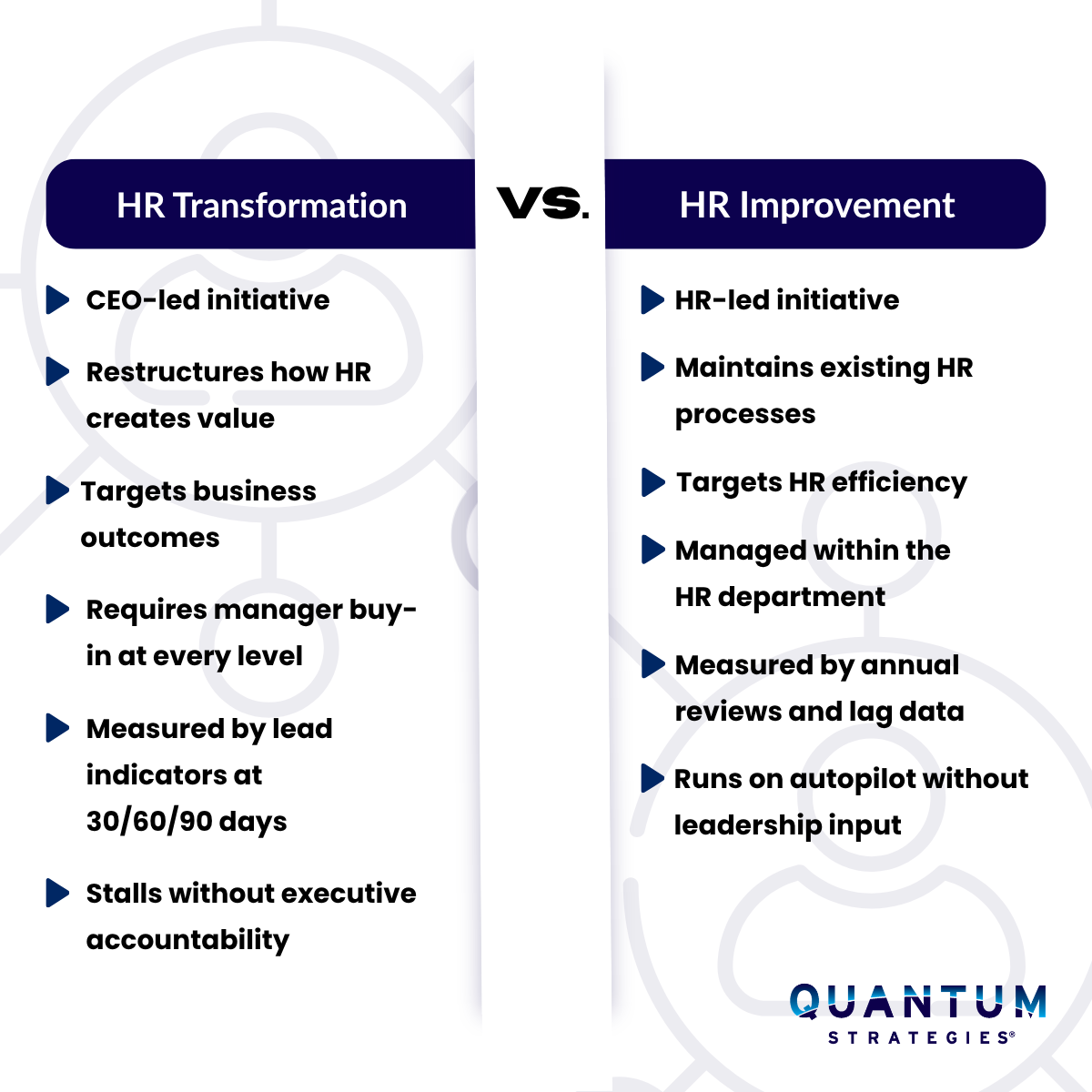
HR Transformation vs. HR Improvement
HR transformation involves a structural redesign of how HR operates and delivers services across the organization. In contrast, HR improvement focuses on gradual changes, such as updating policies, improving a training program, or streamlining a process. For example, a CEO delegating onboarding improvements to HR is HR improvement, while a CEO actively leading a full redesign of HR structure, technology, and operating model is HR transformation.
A Common Mistake: Treating HR Transformation as an HR Project
CEOs delegate the entire initiative to the HR Director, disengage, and assume HR will handle it. As a result, HR builds a new system in isolation, managers remain disengaged, and the rollout hits resistance.
Maximum Accountability emphasizes aligning the CEO’s goals throughout the entire chain of command. Transformation cannot succeed if the CEO is not actively driving alignment from the top.
The specific failure point is middle management, the layer where transformation either gains traction or collapses. When CEOs fail to equip managers with a clear role in HR transformation, they lose them, and their teams follow. An HR operational assessment can help identify areas for improvement before a transformation begins.
Why the Unified Command Concept Matters
The Unified Command Concept emphasizes that successful HR transformation requires alignment at every level of the organization, ensuring that managers and employees understand the mission and their role in achieving it.
According to SHRM, highly engaged employees are 26% more productive and more likely to support transformation when aligned with the organization’s mission and goals.
Why Most HR Transformations Stall at 90 Days
Problem 1: Lack of Lead Indicators
CEOs wait for lag indicators, such as turnover data or engagement scores. Instead, organizations should monitor early signals, such as manager adoption rates, process completion rates, and new hire milestone hits.
Maximum Accountability emphasizes that waiting for lag indicators limits a CEO’s ability to adjust course during the journey.
Problem 2: Lack of Accountability Structure
Organizations establish goals at the start of a transformation but fail to create a structure for tracking progress. Instead, CEOs should implement weekly check-ins and make corrections when necessary.
According to Deloitte, CEOs who successfully achieved their HR transformation spent an average of 18% of their time guiding and shaping the initiative.
Problem 3: Lack of Manager Clarity
Managers are often expected to execute new processes without fully understanding what has changed, what their role is, or what success should look like at 30, 60, and 90 days. Instead, CEOs should provide clear expectations, defined roles, and measurable milestones.
What Successful CEOs Do Differently
Establish Clarity
CEOs own the communication by communicating the why behind the transformation, rather than relying on a memo from HR. In practice, a CEO may hold a mandatory meeting to explain why the transformation is happening and how it supports business growth.
Enforce Accountability
CEOs build an accountability structure from day one by setting goals, identifying lead indicators, and conducting weekly check-ins. In practice, a CEO may require weekly transformation updates tied to specific HR analytics and review progress in mandatory meetings.
Ensure Readiness
CEOs invest in manager preparation before rollout, providing clear expectations, conversation guides, and a defined role in the transformation. In practice, a CEO may require managers to attend training sessions that build their confidence in new HR functions.
How to Know If Your HR Transformation Is on Track
Five signals a transformation is on track at 90 days:
Managers can clearly articulate what changed and why without documentation.
New processes are being followed, not worked around.
HR spends less time on administrative tasks and more time on strategic work.
Leadership has real-time visibility into progress, not just a quarterly report.
Employee questions about the new system are decreasing week over week.
If these signals are not present by day 90, the transformation has likely already stalled.
The Role of HR Consulting in HR Transformation Strategy
Most organizations attempt HR transformation without someone who has done it before, which is where outside expertise changes the outcome. At Quantum Strategies, we work alongside CEOs and HR teams to build strategies designed for the business, not just HR compliance.
In consulting, an engagement typically includes an assessment, a roadmap, implementation of support, and an accountability structure.
Ready to plan an HR transformation? Quantum Strategies helps CEOs build a roadmap around your organization's specific structure and goals. Contact us to schedule a consultation.

Connect


Keep Up with Our Latest News and Insights
Subscribe to Quantum Strategies' latest updates and insights.
Office: Philadelphia, PA | Glen Mills, PA | Washington, DC
Call 610.624.1770
Email: info@QS2500.com
Site: www.QS2500.com