
Tailored HR Solutions as Unique as Your Business
Expert consulting and service to elevate your HR from a headache to a value driver.
Does Your HR Function Make the Grade?
Take our 5-minute quiz and evaluate the effectiveness of your HR function.

How We Help
We Focus on Your HR Needs,
So You Can Focus on Your Mission.
At Quantum Strategies, we understand that effective human resource management is the cornerstone of every successful business, regardless of size. Our mission is to provide tailored HR solutions that align perfectly with your unique business needs and growth stage.
Our Services
Navigating Change with Confidence: Quantum Expert HR Solutions
From Policy Assistance to Leadership Succession Planning, Quantum Strategies is Your Ultimate HR Resource to Solve Your Business Challenges.
HR Operational
Assessments
Unlock the full potential of your HR department. Our collaborative approach brings clarity and efficiency to your HR operations, providing a thorough analysis of your department's structure, costs, effectiveness, and needs.
Comprehensive Analysis: Detailed evaluation of your organization, workgroups, and individual roles for optimized efficiency.
Objective Insights: Receive a clear blueprint highlighting your HR department's strengths, weaknesses, and gaps.
Strategic Recommendations: Actionable plans focusing on technology utilization, communication enhancement, and leveraging department strengths.
HR Consulting and Managed Services
Tailored to align with your unique needs, our HR consulting and managed services enhance operational efficiency and effectiveness, allowing you to focus on your core mission while we optimize your HR investment.
Expert Supplemental Support: Strengthen your existing HR team with specialized expertise to navigate complex HR landscapes.
Personalized, Agile Solutions: Customized services for organizations with or without HR teams, adaptable to your specific requirements.
Goal-Oriented, Clear Communication: Delivering precise, actionable strategies that align with your organization’s goals and ensure successful execution.
Custom HRIS Design and Integration
Revolutionize your HR data management. Our team will evaluate your current human resources technology stack, offer recommendations, and then integrate your new and existing systems with our cutting-edge technology, ensuring seamless data flow and optimized operational efficiency.
Seamless Integration: Connect legacy systems with modern platforms for streamlined data management.
Tailored Design: Custom HRIS solutions uniquely crafted to meet your specific business needs.
Advanced Analytics: Leverage data-driven insights for strategic decision-making and operational excellence.
“Successfully steering through the specialized HR challenges within organizations of all kinds demands expert understanding, strategic planning, and precise implementation. With comprehensive knowledge of these challenges and the right solutions, your business can stay focused and successful in their vital missions.”
William J. Rizzo

Who we Are.
We Focus on Your HR Needs,
So You Can Focus on Your Mission.
At Quantum Strategies, we recognize that proficient management of human resources is fundamental to the success of any enterprise, irrespective of its scale. Our objective is to deliver customized human resource solutions that are in perfect harmony with your distinct business requirements and developmental phase.
Constant Improvement
Commitment to Customers
High Level Of Knowledge
Best Service You Can Get

Why Choose Us
A True Partner to Solve Your Most Complex HR Challenges.
Empowering HR Innovation and Compliance
Commitment to 100% Client Satisfaction
People-First Approach

Peace of Mind:
Handle ongoing compliance with ease

Employee Satisfaction:
Build a positive workplace with engaged employees

Strategic Confidence:
Drive strategy with advanced analytics

Leadership Development:
Equip your team with the tools to lead

2,245 +
Happy Clients

25 +
Years Of Experience

120 +
Professional Team
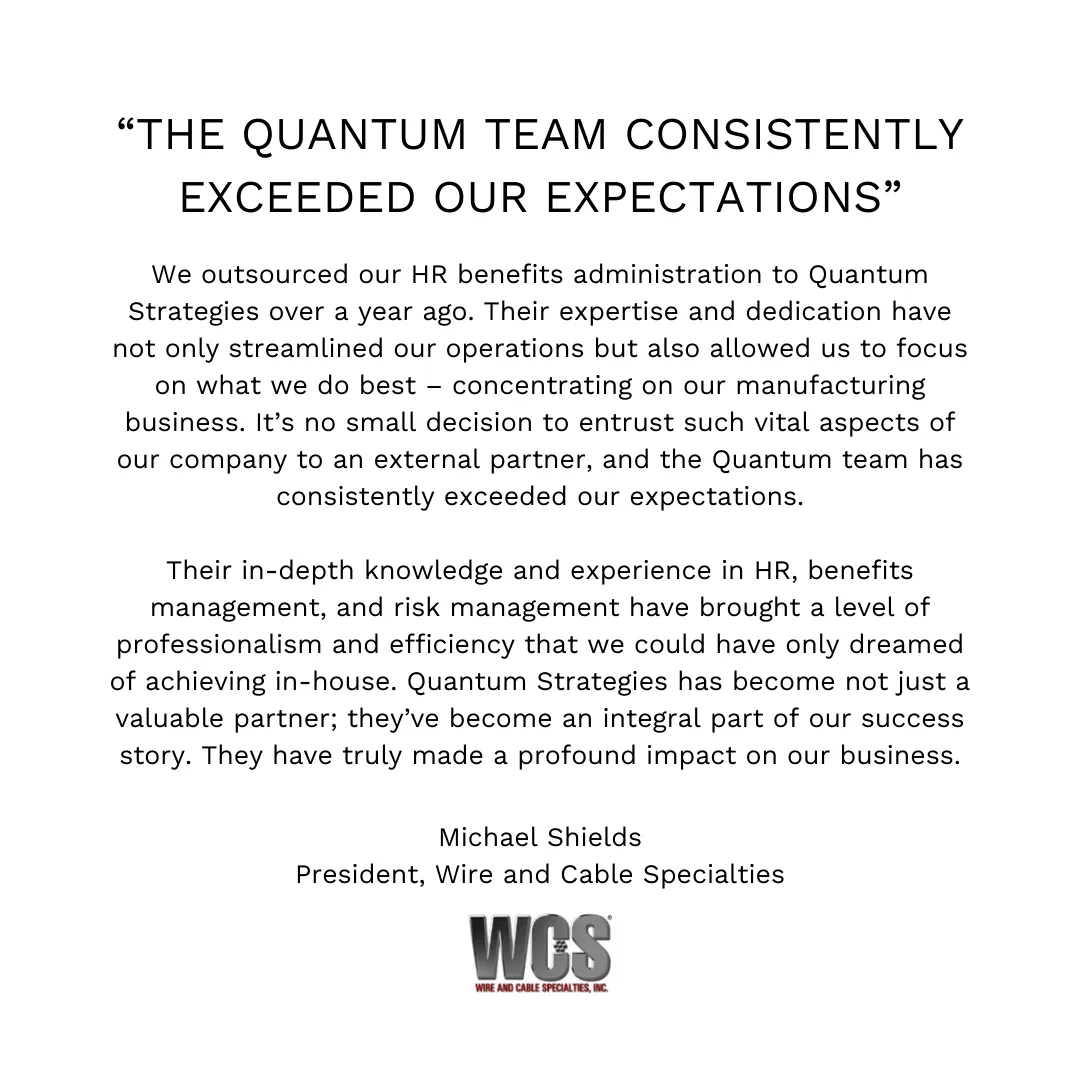
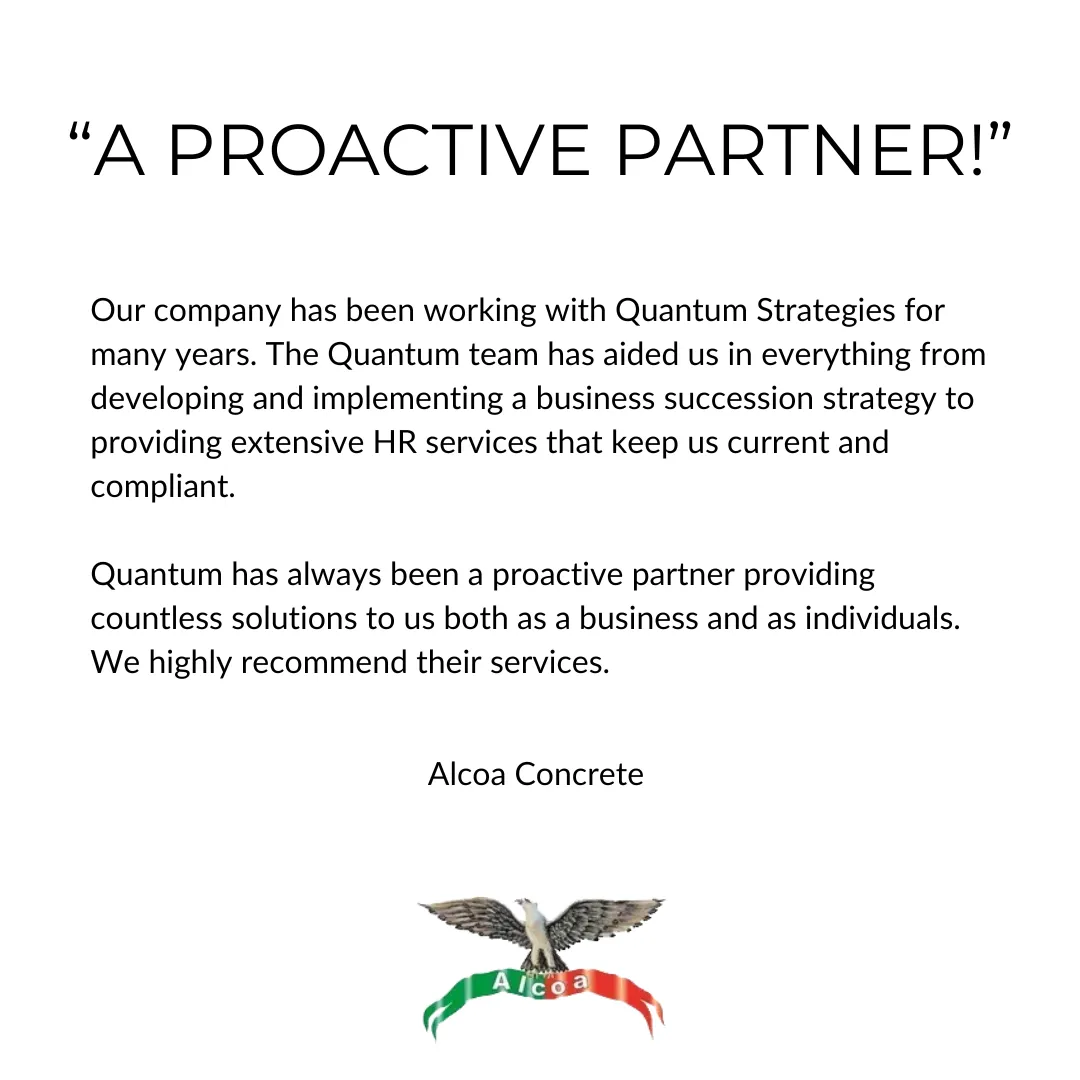
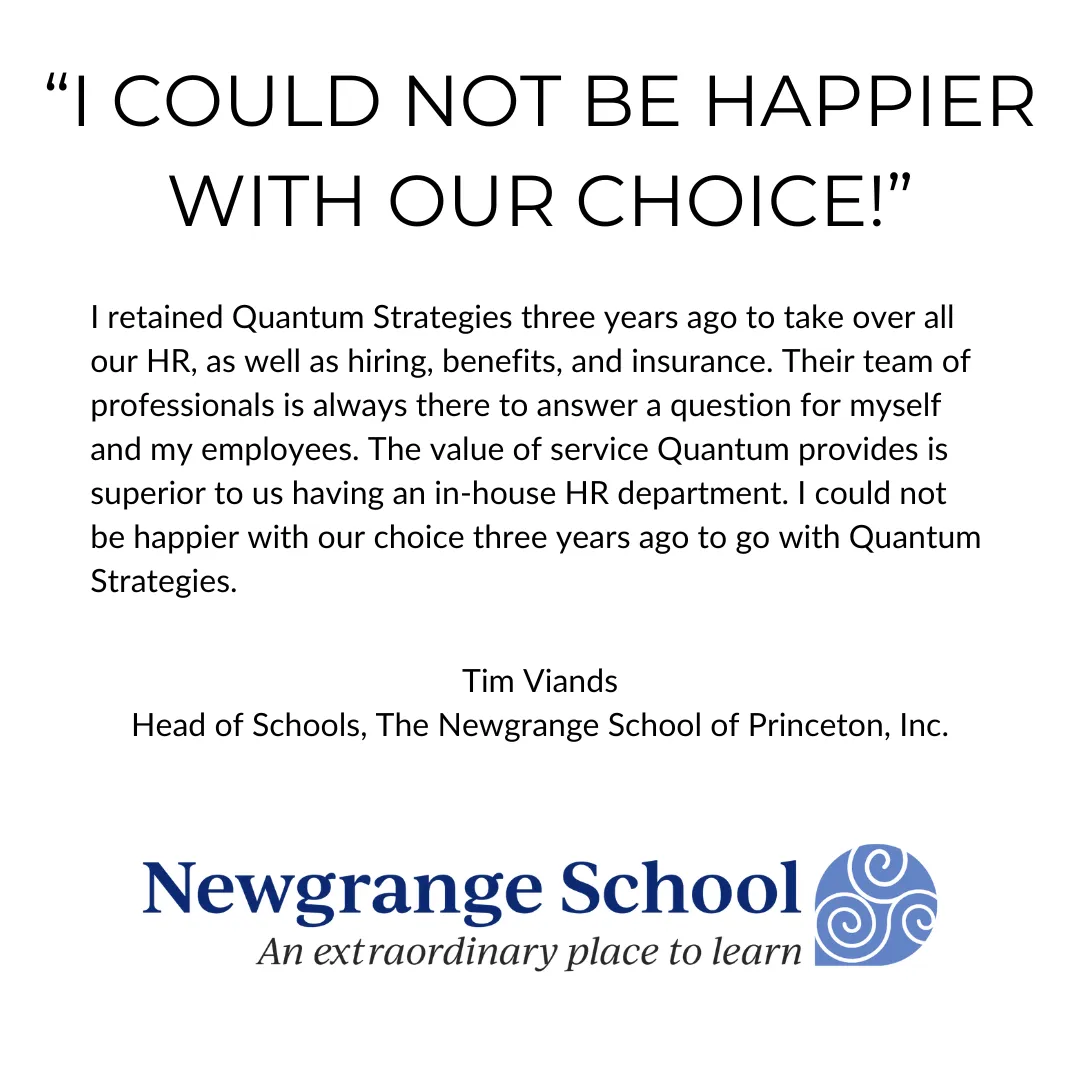
Testimonials
The Quantum Commitment - 100% CLIENT SATISFACTION!
At Quantum, we understand that your satisfaction matters most, and The Quantum Commitment is our way of putting that understanding into action. Experience the difference with a team that is dedicated to making your satisfaction the cornerstone of our service. Because when you choose Quantum, you choose excellence, reliability, and a commitment to exceeding your expectations every time.
Our Resources
Unveiling Proven Strategies and Insights.
Discover actionable tips, expert advice, and industry insights to fuel your journey towards success.


Fostering a Psychologically Safe Workspace
As we navigate the complexities of the post-pandemic world, the importance of mental health in the workplace has surged to unprecedented levels. According to research from the
American Psychological Association, 81% of employees are now actively seeking workplaces prioritizing mental well-being.

Key Challenges Faced by Human Resources in Nonprofit Organizations
The nonprofit sector brings its own set of specialized difficulties, especially in the area of human resources (HR). Although these difficulties may share some common ground with those in the for-profit industry, they possess unique characteristics that require special attention from nonprofit leaders.

Maximizing Business Performance with HR Analytics: Harnessing Data-Driven Insights for Effective People Management
HR analytics involves collecting, analyzing, and reporting data related to human resource management within an organization.
FOUND THESE HELPFUL?
Explore Additional Articles and Resources In Our Blog

What Is People Analytics? A Guide for Mid-Size Organizations
Most CEOs make their biggest people decisions, including who to promote, where to hire, and which teams to restructure, based on gut instinct.
That works fine at 20 employees. At 150, it starts costing money. At 300, it becomes a competitive liability because a competitor is making those same decisions with data.
People analytics for small businesses is becoming a competitive advantage by replacing opinions with data, allowing leaders to improve workforce decisions.
Historically viewed as an enterprise-only capability, modern HR platforms now provide mid-size organizations access to the same insights.
In consulting, a 200-employee manufacturing company noticed turnover was increasing but could not explain why. Using people analytics, leadership discovered that 80% of departures were coming from just two teams under one manager. Without the data, leadership guessed. With it, they acted.
This guide explains what people analytics is, which metrics matter most for mid-size organizations, and how to get started.
What Is People Analytics?
Definition and Scope
People analytics is the practice of collecting, analyzing, and applying workforce data to improve business decisions. Instead of relying on gut instinct, HR leaders and CEOs use metrics such as turnover rates, hiring source quality, performance scores, and engagement data to identify patterns and predict outcomes.
The goal is to provide leadership with real evidence about what is happening with their workforce and why.
What People Analytics Is Not
People analytics is not a data science project. Mid-size organizations do not need a PhD in statistics to use it.
It is not just HR reporting. Reporting tells you what happened, while analytics helps explain why it happened and what actions leaders can take.
Workforce analytics is not limited to enterprise companies. Modern HR platforms make analytics accessible to organizations of any size.
It is not about employee surveillance. The focus is on identifying patterns and trends across groups, not monitoring individual employees.
Why People Analytics Matters for Small Businesses
The cost of poor people decisions continues to increase, as replacing a mid-level manager costs 100% to 150% of their annual salary.
Workforce data is easier to collect, making HR for small businesses more data-driven than ever before, with most HRIS platforms capturing more information than organizations are actually using.
Leadership expectations have shifted, with CEOs now expecting HR to show its impact through measurable results.
The Four Types of People Analytics — From Simple to Advanced
Descriptive Analytics — What Happened
Descriptive analytics uses historical workforce data to understand the current state of the organization.
Examples include turnover rate by department, time to fill by role, headcount by location, and absenteeism by team.
It answers questions about turnover rate, which departments are growing, and how long it takes to fill a role.
The value is creating a baseline and exposing problems that were invisible when workforce data existed in separate systems.
Diagnostic Analytics — Why It Happened
Diagnostic analytics combines workforce data from the HRIS, performance management system, engagement surveys, and exit interviews to identify the root causes behind trends and outcomes.
Examples include analyzing why turnover is higher in one department, understanding why time to fill is longer for engineering roles than sales roles, and identifying which onboarding experiences correlate with 90-day retention.
It answers questions about why turnover is higher in one location, why the best hires come from one recruiting source, and why employee engagement declines after 18 months.
The value is turning a metric into an actionable insight that provides leadership with a clear direction for improvement.

Predictive Analytics — What Will Happen
Predictive analytics uses historical workforce data to forecast future outcomes.
Examples include identifying which employees are at risk of leaving within the next 90 days, predicting which candidates are most likely to succeed based on the characteristics of top performers, and forecasting headcount needs based on business growth projections.
It answers questions about which employees may need a retention conversation and which open roles are most at risk of remaining unfilled.
The value is shifting HR from reactive to proactive by solving problems before they become crises.
Prescriptive Analytics — What to Do About It
Prescriptive analytics uses workforce data to recommend specific actions.
Examples include recommending which manager needs coaching based on team turnover and engagement data, identifying the compensation adjustment needed to retain a high-risk employee, and suggesting learning paths based on skills gap data and career progression.
It answers questions about what actions leaders should take based on the available workforce data.
The value is removing the interpretation layer by not only identifying the problem but also recommending the next step.
According to SHRM, 72% of HR executives using people analytics reported that the approach adds the most value to their organization by enabling more effective decisions.
Key People Analytics Metrics for Mid-Size Organizations
Retention and Turnover
Overall voluntary turnover rate tracks the percentage of employees who leave voluntarily and should be measured monthly rather than annually.
Turnover by manager is one of the most revealing workforce metrics because teams with high turnover under a specific manager reveal a leadership problem.
Turnover by tenure band indicates when employees are leaving, with exits in the first 90 days pointing to hiring or onboarding issues and exits between 18 and 24 months pointing to career development issues.
Regrettable turnover rate measures the percentage of departures involving employees the organization would have preferred to keep.
Hiring and Quality of Hire
Source of hire versus quality of hire indicates which recruiting channels produce candidates who perform well and stay, helping organizations improve their recruiting budget.
Time to fill versus time to productivity indicates that filling a role quickly means little if a new hire takes six months to become fully effective.
Offer acceptance rate identifies compensation or candidate experience issues when qualified candidates decline offers.
Early attrition rate tracks employees who leave within 90 days, representing a loss of recruiting investment that should be measured separately from overall turnover.
Performance and Productivity
Performance distribution indicates how employees are distributed across performance ratings.
A healthy organization has a balanced distribution, and if 80% are rated as exceeding expectations, the rating system is not working.
Manager effectiveness scores combine team performance and engagement data to reveal which leaders strengthen teams and which create challenges.
Goal completion rate indicates the percentage of employees who achieve their goals and identifies whether low completion is caused by poor goal setting or lack of support.
Engagement and Risk
Pulse survey scores by department and manager indicate where engagement is strong and where it is breaking down.
Engagement trend lines provide more insight than a single engagement score by showing changes over time.
Flight risk indicators identify employees who may be disengaging, such as reduced participation, fewer manager 1-on-1s, or declining performance after a period of strength.
How Mid-Size Organizations Get Started With People Analytics
Step 1: Identify One Business Question
Start with a question the business is struggling to answer, such as why turnover is highest in the sales department, which recruiting sources produce the best hires, or why engagement scores dropped in the third quarter.
A single well-defined question keeps the first analytics effort focused and delivers a result leadership can act on.
Resist the temptation to build a comprehensive analytics program before proving its value with one meaningful insight.
Step 2: Audit What Data You Already Have
Start by asking what your HRIS captures, whether the data is complete and accurate, what performance data exists and where it lives, and whether engagement survey results are stored in an accessible location.
Before running any analysis, verify that the underlying data is complete, accurate, and consistent to avoid misleading insights.
Step 3: Connect Your Data Sources
When the applicant tracking system doesn't connect to the HRIS, the HRIS doesn't connect to the performance management system, and the performance management system doesn't connect to engagement surveys, connecting the dots requires manual exports and hours of spreadsheet work.
The solution is to integrate existing systems through a platform that manages multiple HR functions in one place.
Step 4: Start With a Dashboard
The first output should be a dashboard with six to eight key metrics, which is updated monthly and shared with HR and leadership.
Start with metrics such as overall turnover rate, turnover by department, time-to-fill, 90-day retention, engagement score, and performance distribution.
Once the dashboard becomes part of the monthly business review, the questions become more strategic, and the analytics naturally become more sophisticated.
Step 5: Build Accountability Into the Process
Every metric on the dashboard needs an owner who is responsible for the lead indicator that drives it.
During monthly reviews, ask what the data shows, why it is moving the way it is, what actions need to be taken, and who is responsible for them.
Track lead indicators weekly, review lag indicators monthly, and connect both to the business outcome they support.
According to Deloitte, the most mature organizations are 2x as likely to treat people analytics as a core asset that creates competitive advantage.
Real-World Example: People Analytics in Action
A 175-employee professional services firm has a 19% voluntary turnover rate, well above the industry benchmark of 13%. Leadership assumes compensation is the problem and considers an across-the-board salary increase. Before spending the money, the HR Director pulls the data.
The data reveals that three managers have turnover rates above 35%, while the rest of the company averages 11%. Additionally, 70% of departures occur between months 14 and 22, with employees citing lack of career development, unsupported managers, and unclear growth expectations as the top reasons for leaving.
Leadership puts the salary increase on hold after identifying that compensation was not the cause. Instead, the organization focuses on manager coaching, career development, and stronger performance conversations.
After 12 months, turnover drops to 14%, and the organization saves approximately $800K in replacement costs. Ultimately, people analytics helped leadership identify the root cause of turnover, take targeted action, and measure the impact of those decisions.
How Technology Makes This Accessible for Mid-Size Organizations
How to Choose a People Analytics Platform
Look for pre-built dashboards that don't require a data analyst to set up and maintain. The platform should integrate with existing HRIS, payroll, and performance systems, allowing data to flow automatically instead of requiring manual uploads.
Role-based access ensures executives see summary metrics, HR sees operational details, and managers see their team data.
Trend visualization is essential because it shows how metrics are changing over time and whether performance is improving or worsening.
Benchmarking provides context by comparing your metrics with industry averages.
Maximum Accountability's People Analytics Module
Maximum Accountability is an integrated HR technology platform built by Quantum Strategies.
Maximum Accountability's people analytics module enables organizations to improve decision-making by basing decisions on evidence. The module connects more than 50 HR metrics across general HR, performance, and talent acquisition.
As part of an integrated platform, data doesn't need to be exported from one system and imported into another. It's already connected across performance management, engagement, ATS, and compensation modules.
Managers access dashboards built for their teams, HR gains operational insight, and leadership has a strategic view of the workforce, all from the same system.
How Quantum Strategies Helps Mid-Size Organizations Use People Analytics to Improve Decisions
The starting point is one business question, existing data, and the discipline to review insights monthly and take action. Mid-size organizations that build this capability now will have a talent and operational advantage as they scale.
Quantum Strategies helps mid-size organizations build a people analytics strategy with the right platform and the right questions.
At Quantum Strategies, our approach starts by identifying the workforce problem costing your organization the most, analyzing the data available, and selecting the key metric and lead indicator to track progress.
Ready to use people analytics to improve business decisions? Contact us to schedule a consultation.

Connect


Keep Up with Our Latest News and Insights
Subscribe to Quantum Strategies' latest updates and insights.
Office: Philadelphia, PA | Glen Mills, PA | Washington, DC
Call 610.624.1770
Email: info@QS2500.com
Site: www.QS2500.com