
Tailored HR Solutions as Unique as Your Business
Expert consulting and service to elevate your HR from a headache to a value driver.
Does Your HR Function Make the Grade?
Take our 5-minute quiz and evaluate the effectiveness of your HR function.

How We Help
We Focus on Your HR Needs,
So You Can Focus on Your Mission.
At Quantum Strategies, we understand that effective human resource management is the cornerstone of every successful business, regardless of size. Our mission is to provide tailored HR solutions that align perfectly with your unique business needs and growth stage.
Our Services
Navigating Change with Confidence: Quantum Expert HR Solutions
From Policy Assistance to Leadership Succession Planning, Quantum Strategies is Your Ultimate HR Resource to Solve Your Business Challenges.
HR Operational
Assessments
Unlock the full potential of your HR department. Our collaborative approach brings clarity and efficiency to your HR operations, providing a thorough analysis of your department's structure, costs, effectiveness, and needs.
Comprehensive Analysis: Detailed evaluation of your organization, workgroups, and individual roles for optimized efficiency.
Objective Insights: Receive a clear blueprint highlighting your HR department's strengths, weaknesses, and gaps.
Strategic Recommendations: Actionable plans focusing on technology utilization, communication enhancement, and leveraging department strengths.
HR Consulting and Managed Services
Tailored to align with your unique needs, our HR consulting and managed services enhance operational efficiency and effectiveness, allowing you to focus on your core mission while we optimize your HR investment.
Expert Supplemental Support: Strengthen your existing HR team with specialized expertise to navigate complex HR landscapes.
Personalized, Agile Solutions: Customized services for organizations with or without HR teams, adaptable to your specific requirements.
Goal-Oriented, Clear Communication: Delivering precise, actionable strategies that align with your organization’s goals and ensure successful execution.
Custom HRIS Design and Integration
Revolutionize your HR data management. Our team will evaluate your current human resources technology stack, offer recommendations, and then integrate your new and existing systems with our cutting-edge technology, ensuring seamless data flow and optimized operational efficiency.
Seamless Integration: Connect legacy systems with modern platforms for streamlined data management.
Tailored Design: Custom HRIS solutions uniquely crafted to meet your specific business needs.
Advanced Analytics: Leverage data-driven insights for strategic decision-making and operational excellence.
“Successfully steering through the specialized HR challenges within organizations of all kinds demands expert understanding, strategic planning, and precise implementation. With comprehensive knowledge of these challenges and the right solutions, your business can stay focused and successful in their vital missions.”
William J. Rizzo

Who we Are.
We Focus on Your HR Needs,
So You Can Focus on Your Mission.
At Quantum Strategies, we recognize that proficient management of human resources is fundamental to the success of any enterprise, irrespective of its scale. Our objective is to deliver customized human resource solutions that are in perfect harmony with your distinct business requirements and developmental phase.
Constant Improvement
Commitment to Customers
High Level Of Knowledge
Best Service You Can Get


Why Choose Us
A True Partner to Solve Your Most Complex HR Challenges.
Empowering HR Innovation and Compliance
Commitment to 100% Client Satisfaction
People-First Approach

Peace of Mind:
Handle ongoing compliance with ease

Employee Satisfaction:
Build a positive workplace with engaged employees

Strategic Confidence:
Drive strategy with advanced analytics

Leadership Development:
Equip your team with the tools to lead

2,245 +
Happy Clients

25 +
Years Of Experience

120 +
Professional Team
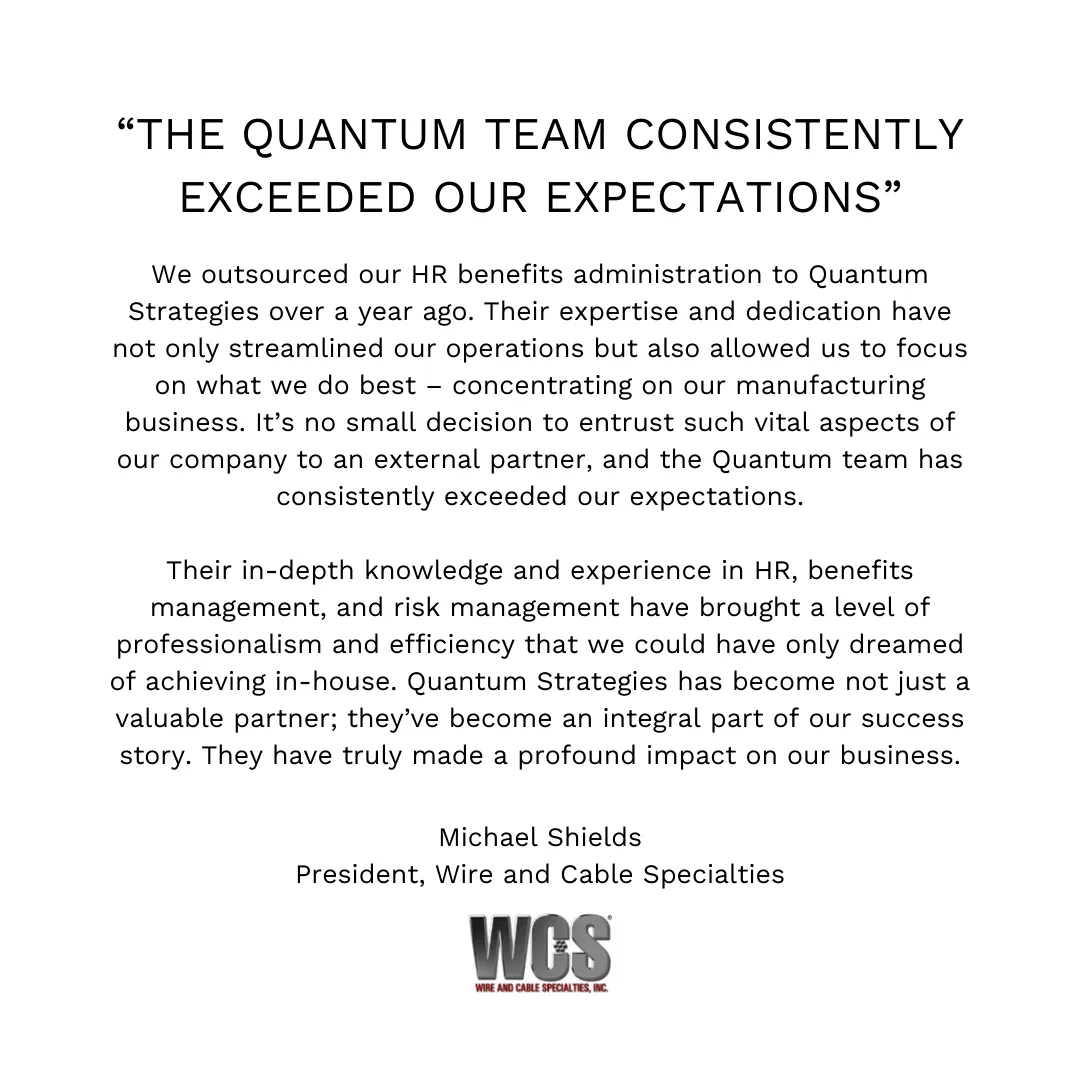
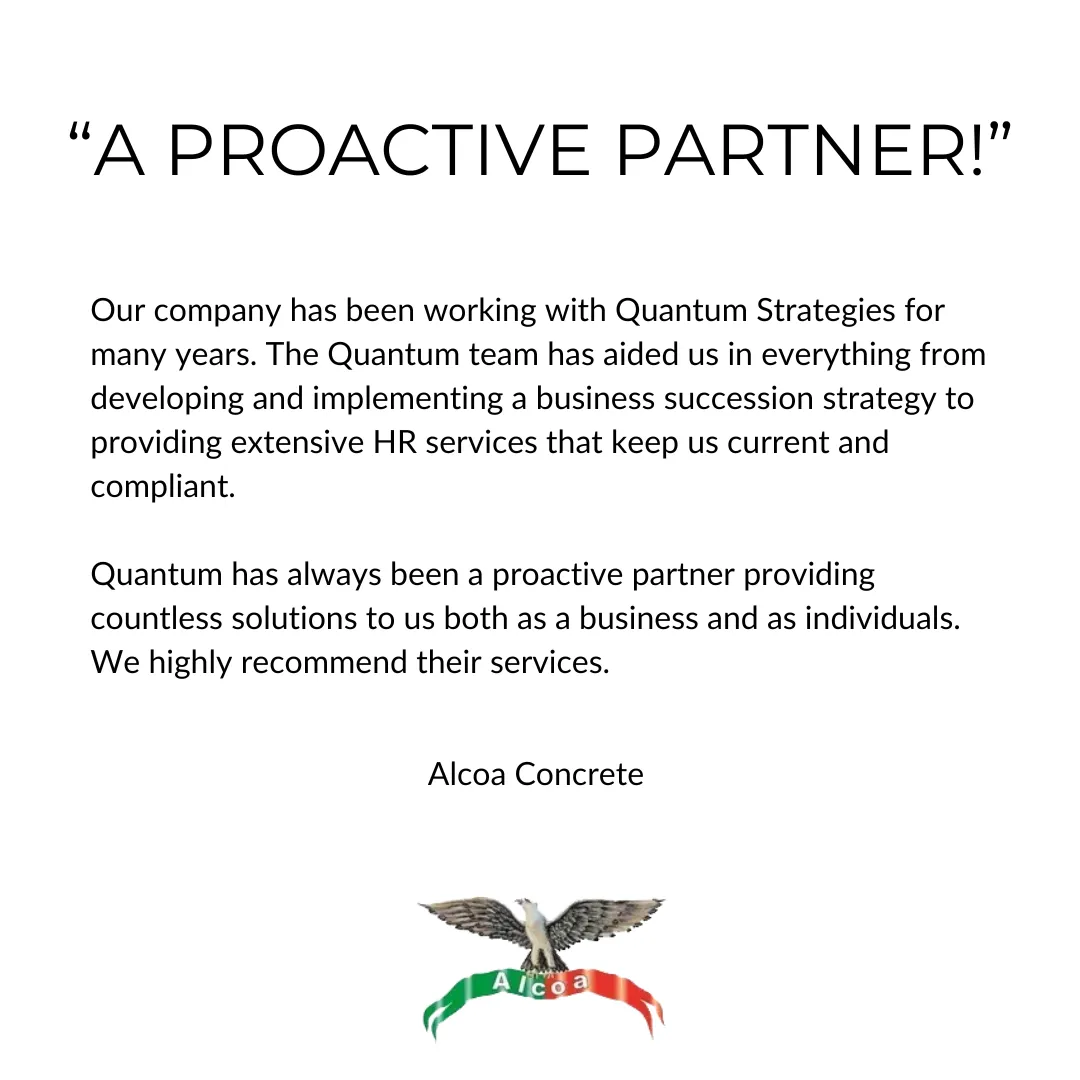
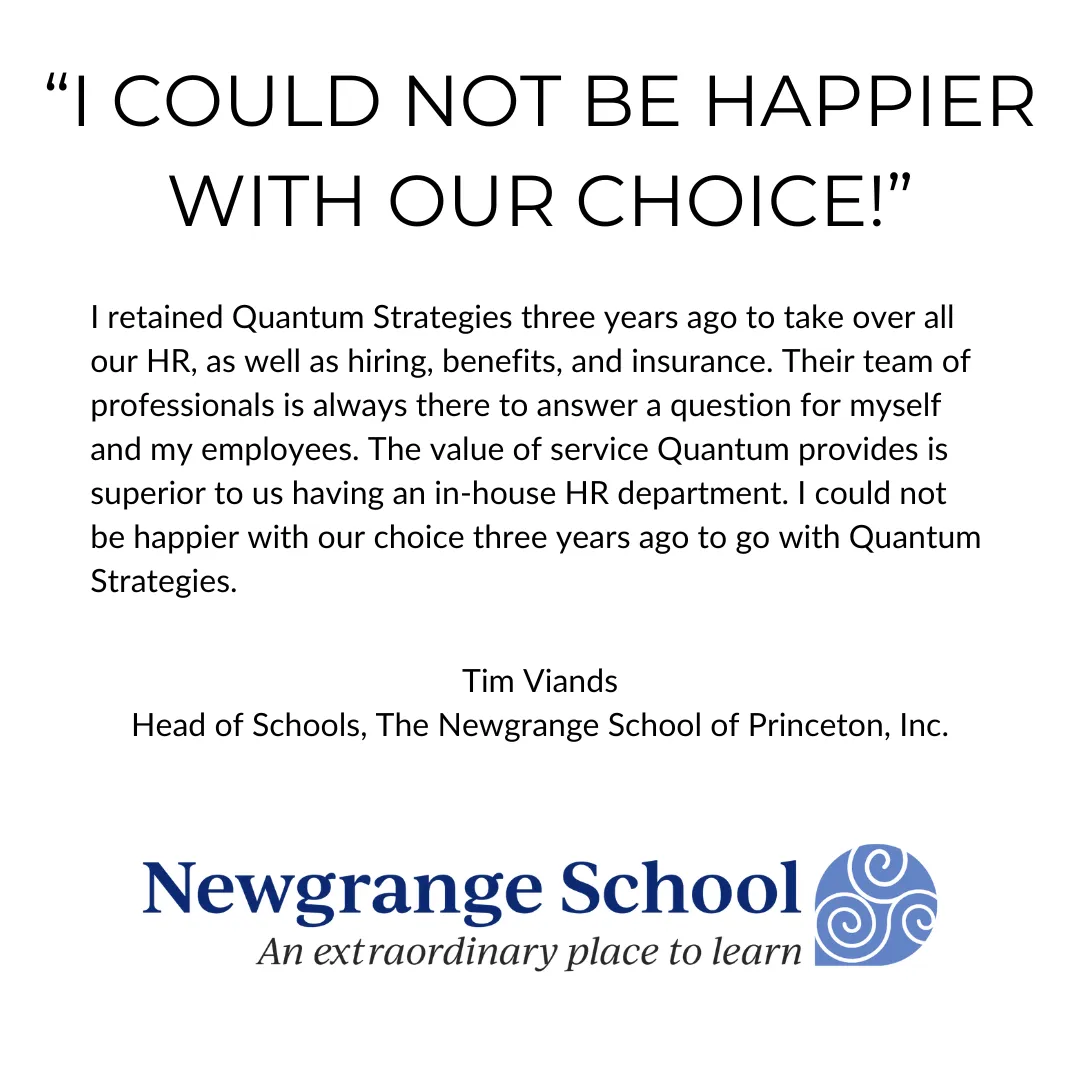
Testimonials
The Quantum Commitment - 100% CLIENT SATISFACTION!
At Quantum, we understand that your satisfaction matters most, and The Quantum Commitment is our way of putting that understanding into action. Experience the difference with a team that is dedicated to making your satisfaction the cornerstone of our service. Because when you choose Quantum, you choose excellence, reliability, and a commitment to exceeding your expectations every time.
Our Resources
Unveiling Proven Strategies and Insights.
Discover actionable tips, expert advice, and industry insights to fuel your journey towards success.


Fostering a Psychologically Safe Workspace
As we navigate the complexities of the post-pandemic world, the importance of mental health in the workplace has surged to unprecedented levels. According to research from the
American Psychological Association, 81% of employees are now actively seeking workplaces prioritizing mental well-being.

Key Challenges Faced by Human Resources in Nonprofit Organizations
The nonprofit sector brings its own set of specialized difficulties, especially in the area of human resources (HR). Although these difficulties may share some common ground with those in the for-profit industry, they possess unique characteristics that require special attention from nonprofit leaders.

Maximizing Business Performance with HR Analytics: Harnessing Data-Driven Insights for Effective People Management
HR analytics involves collecting, analyzing, and reporting data related to human resource management within an organization.
FOUND THESE HELPFUL?
Explore Additional Articles and Resources In Our Blog

Aligning HR Goals with Business Strategy: A CEO’s Practical Guide
Most CEOs can tell you exactly what the business needs to achieve this year. However, very few can explain how aligning HR goals with business strategy contributes to success.
HR focuses on reducing turnover, improving hiring speed, and running performance reviews, while leadership focuses on revenue growth, market expansion, and operational efficiency. Too often, these priorities are not aligned.
In consulting, an organization set an aggressive revenue target that required 40 new hires in the second quarter, only for HR to find out in March. By then, HR was already behind, making it far more difficult to align workforce planning with the revenue target.
Maximum Accountability emphasizes that everyone, from the CEO to the newest team member, should have visible, aligned goals. When HR goals are not aligned with business strategy, the entire organization feels the impact.
This guide provides CEOs with a practical framework to align HR goals with business strategy.
Understanding HR Goals and Business Strategy Alignment
Definition and Scope
Aligning HR goals with business strategy requires designing your people programs, such as hiring, development, performance, compensation, and retention to directly support what the business is trying to achieve. Rather than creating HR goals separately, they should be derived from business goals.
When alignment exists, every HR initiative can be traced back to a specific business outcome, whether that's increasing revenue, supporting expansion, improving productivity, or reducing costs. Without alignment, HR becomes a reactive support function instead of proactively enabling success.
What Misalignment Actually Looks Like
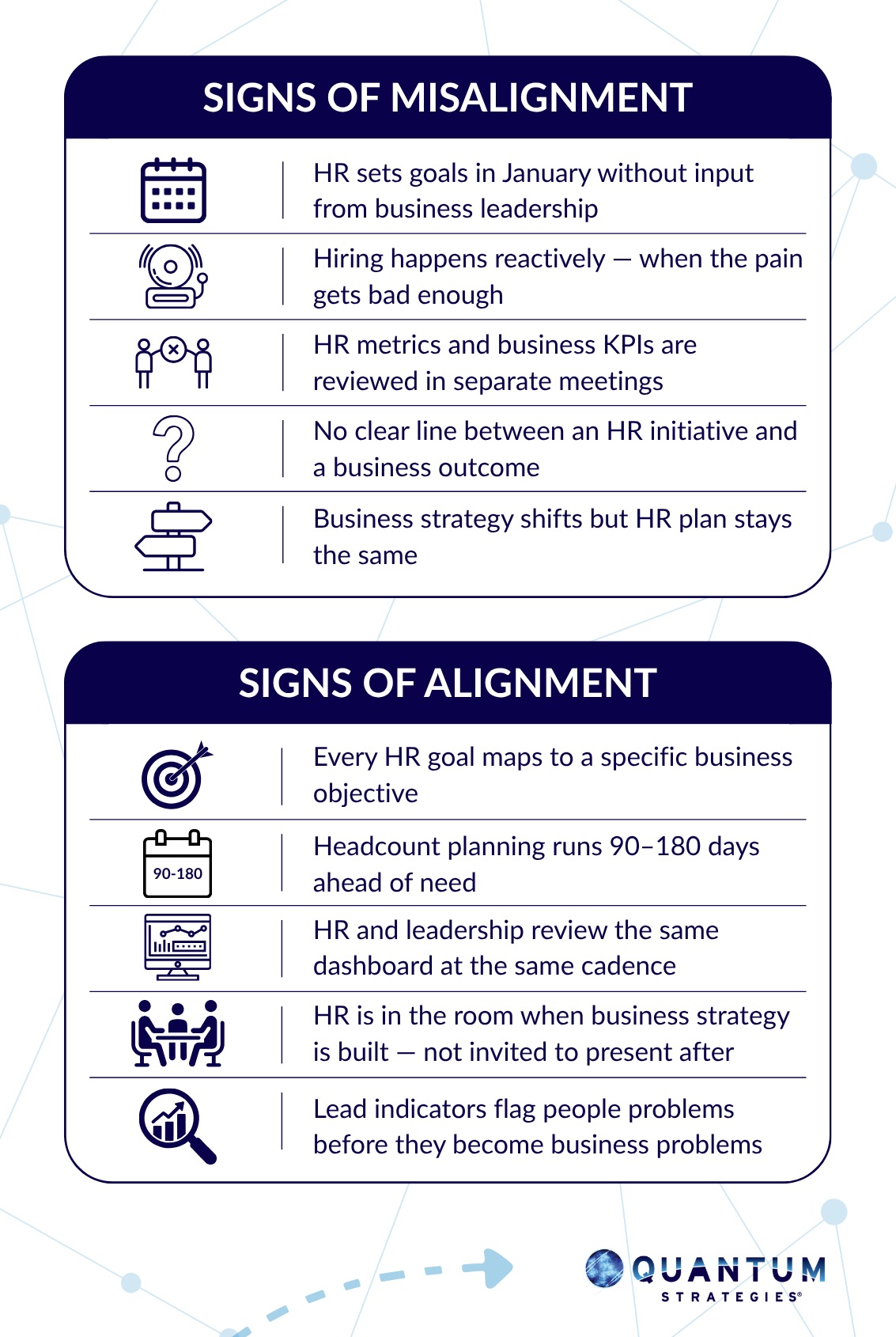
Misalignment often appears in day-to-day decisions that seem reasonable on their own but don’t support the business strategy. For example, HR may set annual goals based on past HR priorities instead of current business goals, while leadership approves HR budgets and reviews metrics without connecting them to key performance indicators.
Hiring plans are often built reactively, with HR filling open roles as they arise rather than planning headcount around business growth projections. Similarly, performance management may operate on its own timeline with metrics that don’t reflect what leadership values.
Why This Gap Exists
HR has historically been measured by HR outcomes rather than business outcomes, causing HR leaders to naturally optimize those internal metrics. Many CEOs don’t realize that achieving alignment requires their direct involvement and cannot be fully delegated to the HR Director alone.
Additionally, business strategy and HR planning are developed through separate processes, led by different owners and operating on different timelines. The result is two parallel plans that may occasionally intersect but are never fully integrated.
The CEO’s Role in HR Strategic Alignment
Why This Starts at the Top
The CEO’s role is to communicate the business vision clearly, enabling HR to translate it into a meaningful people strategy while maintaining accountability for execution across the organization.
Maximum Accountability emphasizes that when the CEO’s vision is not clearly connected to team and individual goals, the organization begins to drift as each function optimizes for its own metrics.
What Successful CEOs Do Differently
Successful CEOs include HR in business strategy conversations before plans are finalized, not after decisions are made. In addition, CEOs establish clear people priorities at the start of each planning cycle.
HR metrics are reviewed alongside business metrics at the same frequency, and accountability is measured by business outcomes. For example, reducing time-to-fill is an HR metric, while meeting a second quarter headcount target is a business outcome.
The One Question That Reveals Misalignment
Ask every HR leader one question about the three biggest business goals the organization needs to achieve this year and how the HR plan directly supports each one. If the answer takes more than 30 seconds or requires translating HR language into business language, alignment is likely broken.
A Practical Framework for Aligning HR Goals to Business Strategy
Step 1: Start With Business Goals Before HR Goals
Before HR sets a single goal, leadership must communicate the most important business goals for the planning period, such as expanding into two new markets by the fourth quarter and increasing revenue by 30%.
At Quantum Strategies, our approach is to identify three to five specific, time-bound goals for each 12-week planning period, assign accountability, and share them throughout the organization, including HR.
Step 2: Translate Business Goals Into People Requirements
Before HR can set meaningful goals, each business objective must be translated into people requirements. For every business goal, HR should identify the talent needed, skills gaps, behaviors that need to change, and culture shifts required to support the goal.
For example, expanding into the Northeast market may require hiring eight regional sales representatives, promoting a manager to Regional Director, and building a compensation structure for the new market. This translation is where HR becomes strategic by anticipating business needs and aligning its people strategy accordingly.
Step 3: Set HR Goals That Map Directly to Business Goals
Every HR goal should have a clear line of sight to a business objective. A strategic framework is to connect the business goal to the people requirement, the HR goal, the lead indicator, and the lag indicator.
For example, if the business goal is to increase revenue by 30%, the people requirement may be hiring 12 new sales representatives by the third quarter. The HR goal would be to fill those roles by July 1, with a lead indicator of six qualified candidates in the pipeline by April 1 and a lag indicator of all 12 hires placed and productive by the third quarter review.
Maximum Accountability emphasizes that the lead indicator enables HR to course-correct before the lag indicator reveals it's too late to influence the outcome.
Step 4: Build a Shared Dashboard
HR metrics and business metrics should be reviewed together rather than in separate reports presented at different meetings. A shared dashboard should include the organization’s key performance indicators, the HR goals tied to each objective, current lead indicator status, and projected outcomes.
Bringing these measures together creates a single conversation between the CEO and HR instead of two parallel conversations that never fully connect.
Step 5: Review at the Same Cadence as the Business
If leadership reviews business performance weekly or monthly, HR alignment should be reviewed on the same schedule. During monthly reviews, evaluate whether lead indicators are being achieved and whether the organization is on track to deliver the business outcomes HR is supporting.
Quarterly reviews should assess whether the HR plan delivered the intended outcomes and identify adjustments for the next quarter. Annual reviews should evaluate whether the people strategy supported the business strategy, where alignment succeeded, and where improvements are needed.
According to SHRM, 59% of HR professionals use strategic goals as key performance indicators, while 40% use revenue and profitability metrics to evaluate people managers.
The Most Common Alignment Mistakes
Mistake 1 — HR Goals Focus on Activities Instead of Outcomes
An activity-based goal focuses on completion, while an outcome-based goal focuses on impact. For example, an activity goal might be completing performance reviews for 100% of employees by December 31, while an outcome-based goal would be ensuring 80% of employees have a documented development plan tied to a business-critical skill gap by December 31.
To fix this, every HR goal should be connected to a specific business outcome. If there is no clear connection to a business result, the goal should be rewritten.
Mistake 2 — Headcount Planning Is Reactive
Most companies hire reactively, waiting until a need becomes urgent, such as when a manager raises concerns, a project slows down, or a key employee leaves. Strategic alignment requires shifting to proactive headcount planning by identifying hiring needs 90 to 180 days before talent is needed.
To fix this, business leaders should identify their people needs at the start of each planning cycle, and the hiring plan should be built directly from those priorities.
Mistake 3 — HR Presents to Leadership Instead of Planning With Leadership
When HR’s role is to present a plan for leadership approval, alignment becomes a one-way process. When HR is involved in building business strategy, alignment happens naturally because people decisions are integrated from the start.
To fix this, HR leaders should be included in business planning conversations early rather than being brought in after decisions have already been made.
Mistake 4 — Alignment Occurs Once a Year
Business strategy shifts and markets change, which means a plan built in January may already be outdated by April. When HR alignment is only revisited during the annual review, the organization operates on a lag instead of responding in real time.
To fix this, CEOs and HR leaders should conduct quarterly alignment checks to assess whether business priorities have shifted and whether HR goals need to be adjusted.
According to Deloitte, 81% of CEOs recognize that work is increasingly performed across functional boundaries, highlighting the importance of continuous alignment.
What Strategic Alignment Looks Like at 90 Days
At 90 days, a well-aligned HR strategy produces visible early signals. These are not final results but lead indicators that the plan is working. Every open role has a hiring timeline tied to a business deliverable; HR can show leadership which business goals it supports and the current status of those efforts, and managers understand how their team’s goals connect to the organization’s objectives.
Performance conversations are occurring on a regular cadence rather than only during annual reviews, and HR is not surprised by business decisions that affect headcount, budgets, or priorities. If these indicators are missing at 90 days, alignment likely failed during the planning phase.
How Quantum Strategies Helps CEOs Build Strategic Alignment
Most organizations need an outside perspective to break the cycle of parallel planning, where HR and leadership develop separate plans that never fully align. Strategic alignment starts by bringing both groups together around the same business goals.
At Quantum Strategies, our approach is to work with both the CEO and the HR Director to build an alignment framework, starting with the business goals and working backward to the people strategy. A typical engagement includes business goal mapping, translating business goals into HR goals, developing a lead and lag indicator framework, designing a shared dashboard, and establishing a quarterly review cadence.
If your HR goals and your business strategy are not fully aligned, contact us to schedule a consultation.

Connect


Keep Up with Our Latest News and Insights
Subscribe to Quantum Strategies' latest updates and insights.
Office: Philadelphia, PA | Glen Mills, PA | Washington, DC
Call 610.624.1770
Email: info@QS2500.com
Site: www.QS2500.com