
Tailored HR Solutions as Unique as Your Business
Expert consulting and service to elevate your HR from a headache to a value driver.
Does Your HR Function Make the Grade?
Take our 5-minute quiz and evaluate the effectiveness of your HR function.

How We Help
We Focus on Your HR Needs,
So You Can Focus on Your Mission.
At Quantum Strategies, we understand that effective human resource management is the cornerstone of every successful business, regardless of size. Our mission is to provide tailored HR solutions that align perfectly with your unique business needs and growth stage.
Our Services
Navigating Change with Confidence: Quantum Expert HR Solutions
From Policy Assistance to Leadership Succession Planning, Quantum Strategies is Your Ultimate HR Resource to Solve Your Business Challenges.
HR Operational
Assessments
Unlock the full potential of your HR department. Our collaborative approach brings clarity and efficiency to your HR operations, providing a thorough analysis of your department's structure, costs, effectiveness, and needs.
Comprehensive Analysis: Detailed evaluation of your organization, workgroups, and individual roles for optimized efficiency.
Objective Insights: Receive a clear blueprint highlighting your HR department's strengths, weaknesses, and gaps.
Strategic Recommendations: Actionable plans focusing on technology utilization, communication enhancement, and leveraging department strengths.
HR Consulting and Managed Services
Tailored to align with your unique needs, our HR consulting and managed services enhance operational efficiency and effectiveness, allowing you to focus on your core mission while we optimize your HR investment.
Expert Supplemental Support: Strengthen your existing HR team with specialized expertise to navigate complex HR landscapes.
Personalized, Agile Solutions: Customized services for organizations with or without HR teams, adaptable to your specific requirements.
Goal-Oriented, Clear Communication: Delivering precise, actionable strategies that align with your organization’s goals and ensure successful execution.
Custom HRIS Design and Integration
Revolutionize your HR data management. Our team will evaluate your current human resources technology stack, offer recommendations, and then integrate your new and existing systems with our cutting-edge technology, ensuring seamless data flow and optimized operational efficiency.
Seamless Integration: Connect legacy systems with modern platforms for streamlined data management.
Tailored Design: Custom HRIS solutions uniquely crafted to meet your specific business needs.
Advanced Analytics: Leverage data-driven insights for strategic decision-making and operational excellence.
“Successfully steering through the specialized HR challenges within organizations of all kinds demands expert understanding, strategic planning, and precise implementation. With comprehensive knowledge of these challenges and the right solutions, your business can stay focused and successful in their vital missions.”
William J. Rizzo

Who we Are.
We Focus on Your HR Needs,
So You Can Focus on Your Mission.
At Quantum Strategies, we recognize that proficient management of human resources is fundamental to the success of any enterprise, irrespective of its scale. Our objective is to deliver customized human resource solutions that are in perfect harmony with your distinct business requirements and developmental phase.
Constant Improvement
Commitment to Customers
High Level Of Knowledge
Best Service You Can Get


Why Choose Us
A True Partner to Solve Your Most Complex HR Challenges.
Empowering HR Innovation and Compliance
Commitment to 100% Client Satisfaction
People-First Approach

Peace of Mind:
Handle ongoing compliance with ease

Employee Satisfaction:
Build a positive workplace with engaged employees

Strategic Confidence:
Drive strategy with advanced analytics

Leadership Development:
Equip your team with the tools to lead

2,245 +
Happy Clients

25 +
Years Of Experience

120 +
Professional Team
Testimonials
The Quantum Commitment - 100% CLIENT SATISFACTION!
At Quantum, we understand that your satisfaction matters most, and The Quantum Commitment is our way of putting that understanding into action. Experience the difference with a team that is dedicated to making your satisfaction the cornerstone of our service. Because when you choose Quantum, you choose excellence, reliability, and a commitment to exceeding your expectations every time.
Our Resources
Unveiling Proven Strategies and Insights.
Discover actionable tips, expert advice, and industry insights to fuel your journey towards success.


Fostering a Psychologically Safe Workspace
As we navigate the complexities of the post-pandemic world, the importance of mental health in the workplace has surged to unprecedented levels. According to research from the
American Psychological Association, 81% of employees are now actively seeking workplaces prioritizing mental well-being.

Key Challenges Faced by Human Resources in Nonprofit Organizations
The nonprofit sector brings its own set of specialized difficulties, especially in the area of human resources (HR). Although these difficulties may share some common ground with those in the for-profit industry, they possess unique characteristics that require special attention from nonprofit leaders.

Maximizing Business Performance with HR Analytics: Harnessing Data-Driven Insights for Effective People Management
HR analytics involves collecting, analyzing, and reporting data related to human resource management within an organization.
FOUND THESE HELPFUL?
Explore Additional Articles and Resources In Our Blog

The 9-Box Talent Grid: How to Use It for Promotion Decisions
Most HR teams have heard of the 9-box talent grid. Some have even built one, but very few use a 9-box talent grid HR strategy consistently to guide promotion decisions.
A common mistake with the 9-box talent grid is that the framework lives in a presentation deck, receives attention during the annual talent review, and then disappears until the following year.
When a role opens up, leadership may find itself debating among three internal candidates. Without a talent assessment grid, promotion decisions can be influenced by subjective judgement rather than measurable performance and potential.
A well-designed 9-box talent grid changes this conversation. The framework gives leadership a shared, objective view of who is performing, who has potential, and who is ready to move forward, guiding promotion decisions based on evidence.
This guide provides a practical overview of how to use the 9-box talent grid to review performance, identify high-potential employees, and guide strategic promotion decisions.
What Is the 9-Box Talent Grid?
Definition and Scope
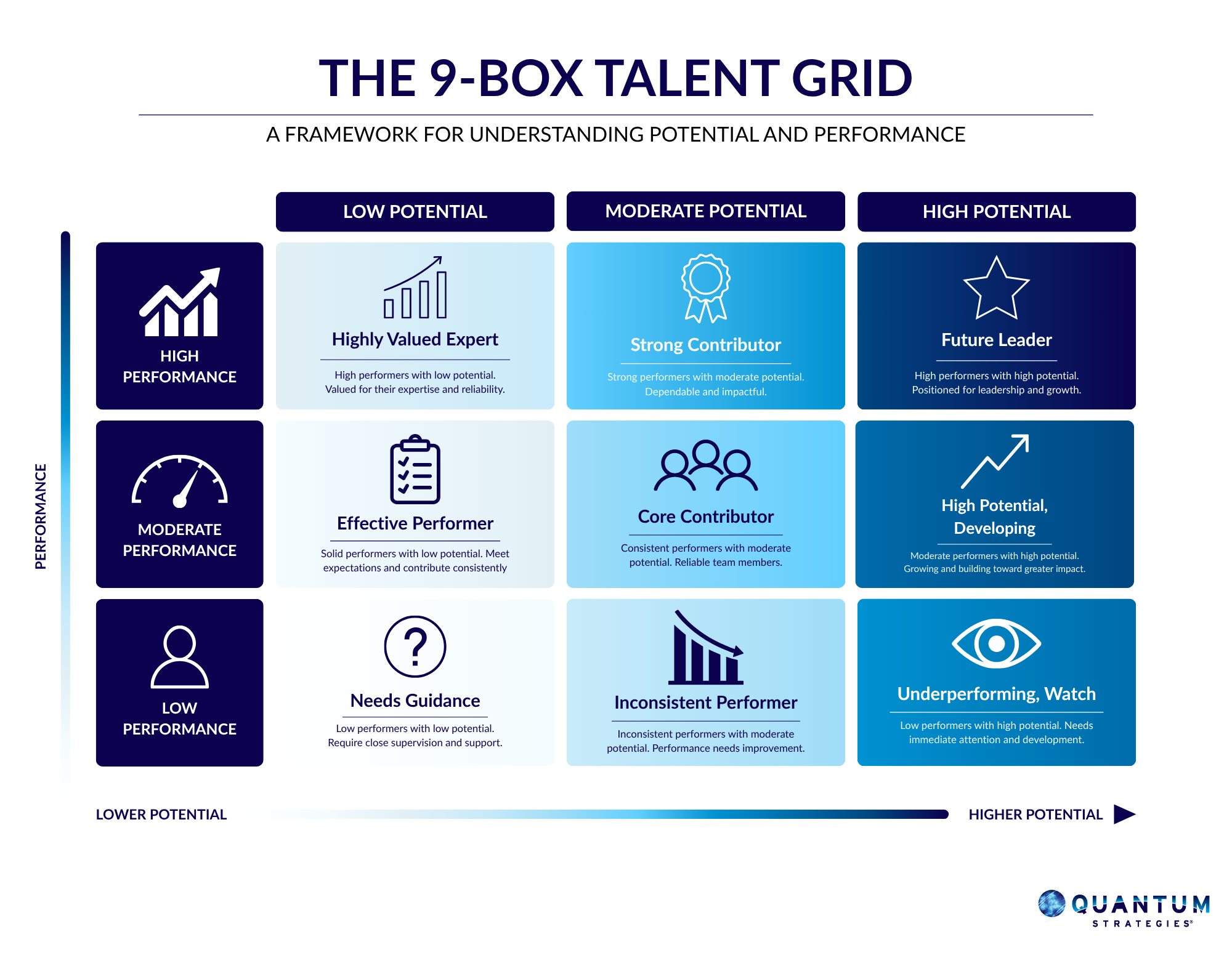
The 9-box talent grid is a talent management tool that plots employees using a 3x3 matrix based on two dimensions: performance and potential. It provides leaders with a visual representation of where employees are performing today and where they have the potential to grow.
The historical significance of the 9-box talent grid dates back to its creation at McKinsey and its later popularization by General Electric in the 1970s. The tool has become one of the most widely used talent management frameworks in HR.
The Two Dimensions
Performance measures how well an employee performs in their current role. Performance reviews should be based on measurable output, goal achievement, and demonstrated results.
Potential measures how likely an employee is to grow into a larger role. Identifying high-potential employees should involve learning agility, leadership behaviors, and adaptability.
The intersection of these two dimensions places each employee into one of nine boxes, ranging from low performance and low potential to high performance and high potential.
Understanding Each Box
Box 9 (high performance, high potential) identifies future leaders. These employees should be prioritized for leadership development, stretch assignments, and succession planning.
Box 5 (moderate performance, moderate potential) represents core contributors. These employees are reliable and consistent, making them strong candidates for targeted development opportunities that build their skills over time.
Box 1 (low performance, low potential) indicates employees who may need performance improvement. Leaders should establish clear expectations, provide structured support, and have honest conversations about whether the role is the right long-term fit.
The remaining six boxes each require a different development and retention strategy. As employee performance and potential evolve, employees can move from one box to another.
Why Most Organizations Struggle to Use the 9-Box Talent Grid
They Run It Once a Year and File It Away
An employee who was a box 5 in January might be a box 8 by June after leading a stretch project. A 9-box talent grid that is not updated at least quarterly can provide outdated information for some of the organization’s most important decisions.
They Use Subjective Ratings Without a Shared Definition
High potential can mean something different to every manager in the room. One manager may rate potential based on technical skills, another on likability, and another on who consistently meets deadlines.
Without a shared definition, the 9-box talent grid can reflect manager bias rather than employee capability. The solution is to define what high, moderate, and low performance and potential look like before the first employee is placed on the grid.
According to Deloitte, 61% of managers and 72% of employees do not trust their organization’s performance management process.
They Don't Share Results with Employees
Organizations often run the 9-box talent grid behind closed doors without communicating employee placements. If high-potential employees do not know they have been identified as future leaders, they have no reason to wait for opportunities that were never communicated.
Top performers leave when they don’t see a clear path for career advancement. The 9-box talent grid only supports retention when employees understand what their placement means for their future with the organization.
Managers Rate Alone Instead of Calibrating
When each manager rates their own team in isolation, the organization can end up with inconsistent standards. Calibration sessions, where managers rate employees together and challenge each other’s assessments, are what make the 9-box talent grid more accurate.
How to Run a 9-Box Talent Review That Actually Works
Step 1: Define Your Rating Criteria Before Anyone Gets Placed
Performance criteria should tie directly to measurable goals and business results.
Potential criteria should include specific behavioral indicators, such as taking on challenges beyond a current role, learning quickly from feedback, influencing others without formal authority, and demonstrating sound judgment under pressure.
Share these definitions with all managers before the calibration session to ensure employees are rated using the same standards.
Step 2: Collect Data, Not Opinions
Collect performance review scores, goal completion rates, 360-degree feedback where available, and manager observations. Each placement should be evidence-based and supported by specific examples instead of opinions.
If a manager says an employee is high potential but cannot point to a specific behavior or result that demonstrates it, the placement is not evidence-based.
Step 3: Run a Calibration Session
Bring managers together to place their teams and challenge each other's placements. The conversation matters more than the 9-box talent grid because calibration surfaces blind spots, inconsistencies, and manager bias.
If one manager's team is disproportionately clustered in the high-performance boxes, their rating scale is likely off.
Step 4: Build an Action Plan for Each Box
The 9-box talent grid is useless without an action plan attached to each placement. Every employee should have a clear action tied to their position on the grid, even if the action is to monitor and maintain.
For high-performance and high-potential employees, define the specific development plan, succession role, and timeline for the next conversation.
For employees in the middle of the grid, identify what would move them up and who owns that development.
For low-performance and low-potential employees, outline the performance improvement process, timeline, and next steps if improvement does not happen.
Step 5: Update It Quarterly
Set a calendar reminder to revisit placements every 90 days. Review whether employees have earned a move up based on a stretch project or whether performance has slipped for a previously strong employee.
At Quantum Strategies, our approach is to review and update the 9-box talent grid every 90 days. A quarterly review cycle provides the right cadence to assess progress before problems compound, keeping the data current and development conversations tied to a real timeline.
How the 9-Box Connects to Promotion and Succession
Promotions Based on Evidence
One of the most common promotion mistakes organizations make is promoting employees based on tenure or position availability. The 9-box talent grid provides evidence by identifying employees who are both performance-ready and potential-ready for the next-level role.
When a promotion opportunity becomes available, you should already have one or two internal candidates who have been identified, developed, and prepared for the role.
According to SHRM, 74% of organizations identify high-potential employees through performance reviews.
Succession Planning That Goes Beyond the C-Suite
Most succession planning conversations focus on senior leadership roles, such as who will replace the CEO, CFO, or VP. However, the most disruptive vacancies occur one level below, including team leads, senior engineers, and regional managers.
A complete 9-box talent grid maps succession risk across every critical level by identifying critical roles and preparing internal successors before vacancies occur.
Using the 9-Box to Retain Top Talent
High-performing, high-potential employees must know that they are valued and have a clear path for career advancement. When those conversations do not happen, top talent looks for opportunities elsewhere.
Use the 9-box talent grid to guide career conversations with high-potential employees by providing a development plan that indicates where you see them in the future and the actions needed to get there.
Making It Systematic — The Role of Technology
Why Spreadsheets Break Down
Running a 9-box talent grid in Excel may work for 20 employees, but it begins to break down as organizations grow. A spreadsheet can quickly become difficult to manage due to version control issues, manual updates, no connection to performance review data, and the lack of an audit trail.
What a Performance Management System Does Differently
A performance management system connects 9-box placements directly to performance review scores and goal tracking without manual data transfer. It tracks employee placement over time, automates quarterly review reminders, and links development plans and performance improvement process documentation to employee records.
Maximum Accountability's Performance Management Module
Maximum Accountability is an integrated HR technology platform built by Quantum Strategies. The performance management module tracks individual goals, houses the 9-box assessment, conducts performance reviews, and manages performance improvement processes all in one place.
With connections to other modules, a high-potential employee identified through the 9-box talent grid can be immediately enrolled in a learning path through Maximum Accountability or flagged for a succession planning conversation.
Common Questions About the 9-Box
Should You Tell Employees Where They Place?
Yes, with context. You should not simply hand an employee a 9-box talent grid with their box circled. Instead, you should have a development conversation informed by the assessment.
High-potential employees should know they have been identified, as this can increase engagement and retention.
Employees in lower boxes should receive honest, specific feedback rather than vague encouragement.
How Do You Handle an Employee Who Disagrees with Their Placement?
First, make sure the placement is defensible. If a manager cannot explain the rating with specific examples, the employee is right to question it.
If the placement is defensible, the conversation becomes focused on what was assessed, what would change the assessment, and the employee’s development plan.
How Many Employees Should Be in Each Box?
A healthy distribution includes 10–15% of employees who are high performers with high potential, 60–70% in the middle range, and 10–15% in the lower boxes.
If 80% of employees are in the top three boxes, rating standards may be too loose.
If 80% are in the bottom three boxes, it may indicate a hiring or development issue.
How Quantum Strategies Helps Organizations Make Better Promotion Decisions
A successful 9-box talent grid requires more than an annual talent review. It relies on consistent performance reviews to identify high-potential employees and support promotion decisions.
At Quantum Strategies, our approach is to help organizations implement a 9-box talent grid that supports promotion decisions. A typical engagement includes defining performance and potential, facilitating calibration sessions, integrating the 9-box talent grid into performance management, developing succession planning, and establishing a quarterly talent review.
If your organization is looking for an integrated performance management system with built-in assessments to determine potential and performance review data for a built-in 9-box talent grid, schedule a demo with us today.

Connect


Keep Up with Our Latest News and Insights
Subscribe to Quantum Strategies' latest updates and insights.
Office: Philadelphia, PA | Glen Mills, PA | Washington, DC
Call 610.624.1770
Email: info@QS2500.com
Site: www.QS2500.com